


I’m sitting in a swanky restaurant in Los Angeles, trying to look like I belong there.
I don’t.
The room has that particular L.A. glow. Low light, beautiful people, people wearing t-shirts that cost more than my first car. Across from me is the showrunner of a television series you definitely know.
I knew his work long before I knew his name. I’d watched it as a fan and studied it as a storyteller. His work had been inside my head for years. Now he was sitting a few feet away, casually deciding what to order.
I was doing my damn best to appear normal.
Inside, I was seventeen years old again.
I could feel every credential I’d ever earned falling out of my pockets. Twenty years building brands. Thousands of ideas. Companies built. Rooms won and lost. None of it seemed to matter.
My brain had reached its verdict.
“YOU DO NOT BELONG HERE.”
Right before the panic fully set in, my friend Aaron introduced me.
“Pete is one of the best storytellers and brand builders I know.”
The showrunner looked up and smiled.
“Oh,” he said. “I thought you were just an AI automation guy.”
Four seconds.
That was all it took.
He wasn’t trying to insult me. He was telling me what he saw.
And what he saw was the version of myself I’d been advertising.
For months, I’d talked about AI constantly. Adoption, agents, automation, transformation. I was so busy proving that I understood the future that I’d buried the twenty years that made me useful in the first place.
The stories and scars. The taste. The pattern recognition. The ability to sit inside a messy problem long enough to see a way through it. I am a maker, marketer, entrepreneur, and most importantly, a human with a unique point of view.
And I’d taken everything I’d earned and hidden it behind a tool anyone could rent for less than the coffee sitting on the table.
The comment hurt because it was true.
I’d made the machinery visible and the craft invisible.
The rented layer
A lot of smart people are making the same mistake.
Founders and experienced operators are reducing themselves to the tools they use. Strategists are becoming prompt people. Writers are becoming content machines. Agency owners are selling speed when their real value has always been judgment.
I think of this as tech sharecropping.
You build your identity and your value on rented land. The platform owner can change the price, improve the machinery, or give the same equipment to everyone else in your market.
You may become faster. You may make more things. That doesn’t mean you’re building an advantage.
The AI conversation makes this easy to forget because it’s obsessed with the Platform du jour or best AI model this week. Every week brings a new comparison, leaderboard, or declaration that one model has made the previous one obsolete.
I use these tools every day. I test them, push them, and sometimes break them. This isn’t an argument against the tech.
It’s an argument against mistaking access for advantage.
Your competitor can access the same model. So can the freelancer underbidding you. Your client can open the same blank chat window and type a version of the same request.
The model can’t be the whole moat because you don’t own it.
What you own is everything you bring to it.
The prompt was never the whole point
The AI world has started calling this context engineering.
Strip away the technical language and the idea is straightforward. Models produce better work when they receive the right information for the job. That includes source material, examples, constraints, decision rules, and a clear picture of what good looks like.
The answer is rarely a more theatrical prompt.
For the last few years, people have treated prompting like spell casting. Find the right phrase. Assign the model an impressive role. Tell it to breathe deeply, channel a genius, and produce something extraordinary.
Sometimes those tricks help. They don’t replace substance.
You can tell a model to act like the best strategist in the world. It still doesn’t know why you rejected the last three campaign ideas. It doesn’t know the phrase a customer used when they finally admitted what was wrong. It has never seen the proposal that won the biggest deal in your company’s history or the one that died in procurement.
Without those things, it’s guessing.
The most useful distinction isn’t between good prompts and bad prompts.
It’s the latent space between the request and the brief.
A request tells the model what you want.
A brief gives it enough of your world to make intelligent choices.
Your business is leaking memory
Here’s the strange part. You probably already possess most of the context you need.
It’s scattered across your call transcripts, proposals, project notes, emails, Slack threads, voice memos, and postmortems. Some of it’s trapped inside the head of the person everyone waits for before the work can continue.
It’s hiding in ordinary moments.
A buyer stops giving you the polished answer and admits what they’re afraid of.
A founder rejects a headline and explains why it feels wrong.
A project falls apart, then teaches the team something that never makes it into the next kickoff.
A senior person makes a tiny decision that changes the entire direction of the work. Everyone else sees the decision. Nobody captures the reasoning behind it.
That material isn’t just digital exhaust. It’s the memory of the business, and that’s where the magic lives.
Most companies lose pieces of that memory every day. Meetings happen, decisions get made, and people move on. The founder gives the same correction six weeks later because the first correction never became a standard.
Then the company points an AI model at a pile of files and wonders why the answer feels generic.
The model may be working perfectly. The business hasn’t made its knowledge usable.
Your context isn’t the number of documents you can upload. It’s the record of how your company notices things, makes choices, learns, and communicates.
That record becomes more valuable each time you use it.
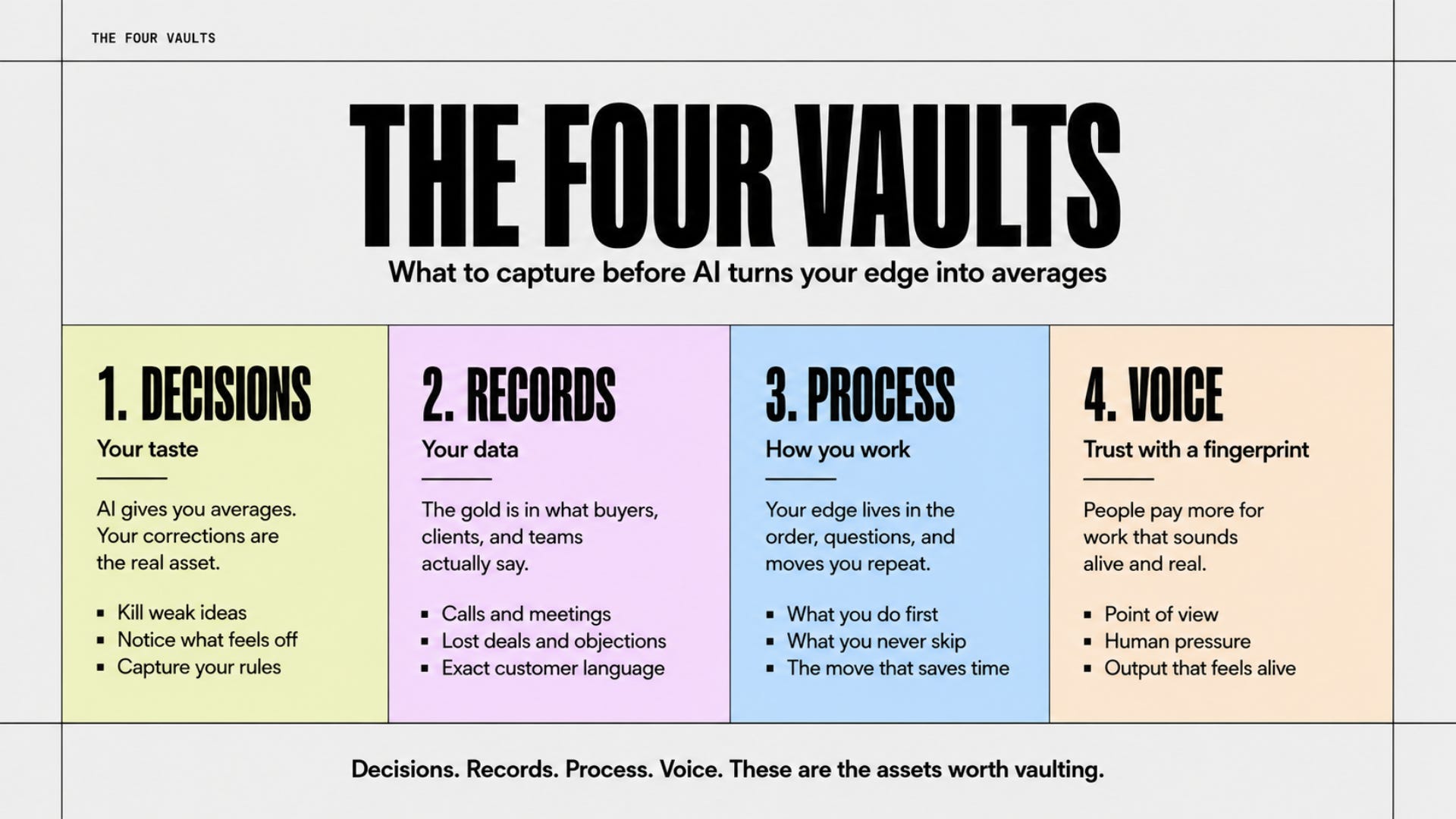
The four vaults
I use four vaults to organize this material.
Not because every business problem needs a four-box diagram. The vaults are simply a way to keep four different kinds of value from collapsing into one large folder called “knowledge.” or worse a “company brain” that everyone is selling you on X or LinkedIn but falls apart after using it for a week.
Decisions
The Decisions vault holds your judgment.
This is where taste becomes teachable.
Taste often sounds mystical because experienced people make decisions faster than they can explain them. They know a strategy is weak before the evidence is neatly organized. They can sense when an offer is carrying too much weight or when a clever headline is hiding an empty thought.
A model doesn’t begin with your judgment. It begins with patterns gathered from other people’s work.
Each time you correct the model, you reveal part of your own decision system.
“That claim needs proof.”
“We are explaining our process before the buyer cares.”
“This sounds polished, but it has no tension.”
“This idea is interesting. It isn’t useful.”
Don’t throw those corrections away after fixing the draft. Save the reason behind them.
Over time, they become a taste file. Not a vague manifesto filled with words like bold and human. A useful taste file contains rules, examples, and the reasons those standards matter.
Records
The Records vault holds what actually happened.
This includes sales calls, lost deals, customer interviews, project outcomes, client feedback, and the language people use when they stop performing.
I record my calls because I want the market’s description of the problem, not the version I invented in a conference room.
Buyers rarely speak in positioning statements. They say things like, “I don’t wanna look stupid in front of my team.” They admit that everyone is busy but the business is standing still. They tell you that the company bought the tool, trained the staff, and watched nothing change.
That language has weight because it came from a real moment.
Your customers are often better copywriters than you are. They’re closer to the fear.
The value isn’t only in collecting quotes. The larger prize is the pattern that appears across conversations. What triggers the search for help? Which concern keeps returning? What do people need to believe before they move?
The records turn your opinions into evidence.
Process
The Process vault holds how the work really happens.
Not the polished case study where the project moves from discovery to strategy with suspicious ease. I mean the decisions, checks, shortcuts, and course corrections that make the work good.
Most experienced people carry this knowledge in their bodies. They notice something and change direction. They ask a question that seems obvious to them and completely changes the room.
For many founders, this knowledge lives in the worst possible place.
Their head.
That feels like expertise until the entire team needs access to it at once. Then expertise becomes a traffic jam.
AI can’t scale a process you’ve never explained. Your team can’t follow a standard that exists as an UNdocumented feeling.
Record yourself doing the task. Narrate the parts you usually skip when explaining it. Talk about what catches your attention and what causes you to abandon one direction for another.
The parts that feel embarrassingly obvious are often the parts everyone else needs.
Voice
The Voice vault holds the shape of your thinking.
Voice isn’t a list of favorite words. It isn’t adding a joke to the second paragraph or asking the model to sound punchier.
Your voice includes the things you notice, the tension you’re drawn toward, and how long you allow an idea to develop before you name the lesson.
Most AI writing isn’t terrible. That’s part of the problem.
The sentences are clean. The structure is visible. The conclusion arrives on schedule. Nothing is technically broken, but nobody seems to be home.
There’s no pressure inside the writing. No risk. No sense that a person has lived through the idea and might have something at stake.
A good voice file should help a model understand how you think, not merely how you decorate sentences. It should contain real writing, rejected language, beliefs, rhythm, and examples of work that feels unmistakably yours.
The model can produce words.
Your context gives those words a reason to exist.
Homework for Work
Matthew Dicks has a practice called Homework for Life.
Each day, he records one small storyworthy moment—the kind that would otherwise disappear if you didn’t catch it. Not the whole story. Just the moment.
Over time, those entries become a record of a life that memory would have erased.
I became so obsessed with this that I wouldn’t stop. So obsessed that I ended up helping him build it into an app so everyone could do it too.
I think businesses need a version of that practice.
Call it Homework for Work.
At the end of each week, capture the moments that revealed something useful about the business.
What did a buyer say that changed your understanding of the problem?
Which decision did you make that would be difficult for a less experienced person to explain?
What correction did you give that you never want to give again?
Where did the work change direction, and what caused it?
This isn’t a meeting summary. Most summaries preserve what was discussed and lose what mattered.
Homework for Work saves the moments when the truth became visible.
Those moments are the raw material for the vaults. A buyer’s admission belongs in Records. A creative correction may become a Decision rule. A change in direction might expose part of the Process.
The companies that become meaningfully better with AI won’t simply have access to better tools.
They’ll become better at remembering what they learn.
The flywheel
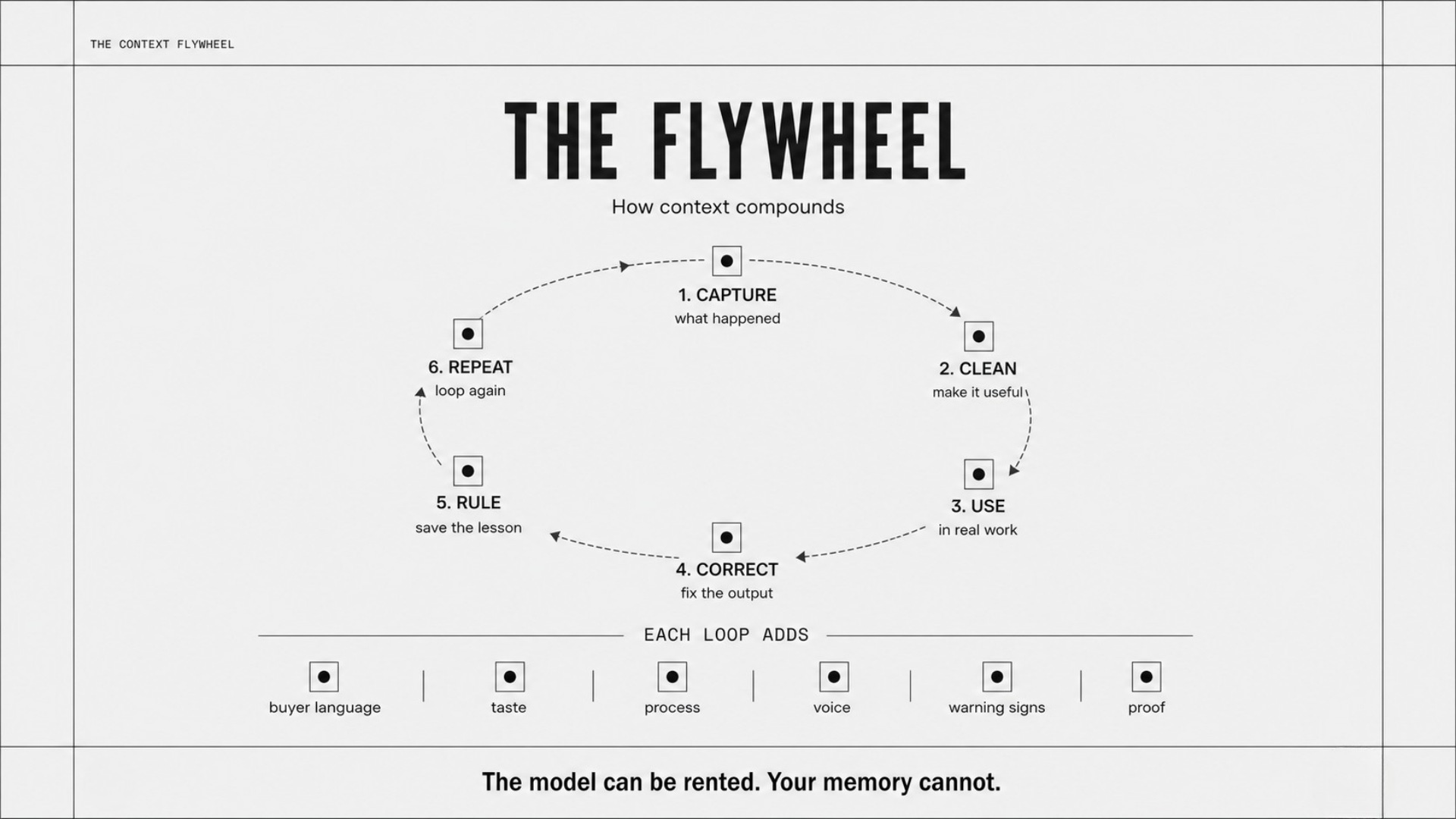
Once you treat context as memory, the system isn’t complicated.
Capture something that happened. Turn it into a usable form. Apply it to real work. Correct what comes back. Save the correction.
A sales call improves the buyer-language bank. A difficult project adds a warning to the process. A rejected draft makes the taste file more precise.
Most people use AI like a vending machine. They enter a request, receive an answer, and start from zero again the next morning.
A context system carries knowledge forward.
The proposal you write next month should benefit from the objection you heard today. A new employee should have access to the thinking behind your standards, not only the finished examples. The AI shouldn’t repeat an error you corrected three times already.
A competitor can buy access to the same model tomorrow.
They can’t buy the history of your decisions.
What this changes for service businesses
AI didn’t make your experience worthless. It just exposed how little of that experience had been captured.
When judgment lives only in your head, the technology feels threatening. It appears to be learning the surface of a skill you spent years developing.
When your judgment becomes context, the relationship changes.
The model can prepare the work, compare options, find patterns, or create a first draft using the standards you’ve already defined. The expert remains responsible for the decisions that matter. The system simply stops asking that expert to rebuild the starting point every time.
That changes the economics of a service business.
You’re no longer using AI only to do ordinary work faster. You’re allowing your best thinking to reach more work without turning every output into a pale imitation of the founder.
The goal isn’t to remove the expert. It’s here to stop wasting the expert’s time.
That’s also how you avoid the end-shittification of everything AI touches. You don’t fight generic output with louder instructions. You give the system more truth, stronger standards, and real examples.
Build the first version this week
Don’t turn this into an enterprise knowledge program or a company brain like all the fancy tech-bro CEOs are talking about. You don’t have their resources, and you don’t need them to just get started right now.
Pick one recurring piece of work. It could be a proposal, a client brief, a sales follow-up, or a strategic review.
Then gather the context that work deserves.
Start with evidence. Find the calls, outcomes, and examples connected to the task. Add the decision rules the work must respect. Document the process just far enough that another person could follow it. Include real samples of your voice.

Then create a brief.
The best prompt engineers aren’t searching for magic sentences. They’re designing a clear job for the model. They define the source of truth, show it examples, establish constraints, and explain how the result will be judged.
The prompts below are built around that discipline.
The Context Audit
Use this to find the knowledge your business already owns.
I am building a context system for this recurring business task:

[DESCRIBE THE TASK]

Review the material I provide and organize the useful information into four categories:

DECISIONS
Standards, judgment calls, approvals, rejections, and tradeoffs.

RECORDS
Buyer language, calls, proposals, outcomes, objections, project history, and proof.

PROCESS
Steps, handoffs, decision points, quality checks, and places where human judgment matters.

VOICE
Point of view, recurring language, rhythm, stories, metaphors, humor, phrases to avoid, and examples that sound like us.

For every finding, include:

- The source
- The exact evidence
- Why it matters to the task
- Whether it appears current, outdated, contradictory, or uncertain

Do not create rules from a single example unless you label them as a hypothesis.
Do not invent missing information.
Do not treat an opinion as a fact.

Finish with:

- The ten most valuable context assets
- The most damaging gaps
- The first three things we should capture next

MATERIALS:

[PASTE OR ATTACH MATERIALS]
The Buyer Truth Miner
Use this with recorded sales or customer calls.
Analyze these sales or customer call transcripts.

Use only the transcripts as evidence. Include the exact quote and source call for every conclusion.

Identify:

- The language buyers use to describe the problem
- The personal or professional stakes behind the problem
- The event that made the problem urgent
- What buyers need to believe before they will act
- The objections that slow the decision
- The moment when their level of interest changes

Separate repeated patterns from rare but revealing comments.

Do not polish the buyer’s language.
Do not invent motivations.
Do not treat one person repeating a concern as evidence of a wider pattern.

Then create:

- A buyer-language bank containing the strongest quotes
- Messaging ideas grounded in those quotes
- Claims our current marketing should stop making
- Questions we should ask on future calls

TRANSCRIPTS:

[PASTE OR ATTACH TRANSCRIPTS]
The Taste File Builder
Use this to turn your feedback into standards another person can apply.
I will provide examples of work I approved, work I rejected, and the feedback I gave.

Identify the judgment rules behind my choices.

Create a rule only when it is supported by multiple examples or by an explicit statement from me.

For every rule, include:

RULE
Write it as a specific “We always” or “We never” statement.

PURPOSE
Explain the value the rule protects or the problem it prevents.

EVIDENCE
Reference the examples that support it.

GOOD EXAMPLE
Show what following the rule looks like.

FAILURE MODE
Show what happens when the rule is ignored.

CONFIDENCE
Label the rule confirmed, probable, or uncertain.

Also identify contradictions in my feedback and preferences that appear specific to one project.

Do not flatter me.
Do not use vague words such as bold, premium, authentic, or strategic unless you define what they mean in practice.

APPROVED WORK:

[PASTE]

REJECTED WORK:

[PASTE]

FEEDBACK:

[PASTE]
The Process Extractor
Use this after recording yourself completing a task.
Turn my narrated workflow into a process another person could follow.

For each step, document:

- The goal
- The input required
- The action taken
- The decision being made
- The rule guiding that decision
- The quality standard
- The common failure
- Where human judgment is required
- How AI could prepare, compare, check, or draft
- The output created

Then identify:

- Steps I skipped because they feel obvious to me
- Places where the process contradicts itself
- Decisions that rely on undocumented taste
- Handoffs likely to create delay or rework
- Work that should remain human-led

Do not make the workflow cleaner than my description.
Do not add generic steps I did not mention.
Flag missing information instead of filling it with assumptions.

Finish with a one-page checklist and the questions someone would need answered before completing the work without me.

NARRATION:

[PASTE TRANSCRIPT]
The Context Brief
Use this before asking the model to produce important work.
TASK

What needs to be created or decided?

[DESCRIBE THE TASK]

AUDIENCE

Who is this for?
What do they care about?
What are they likely to doubt?

[DESCRIBE THE AUDIENCE]

STAKES

Why does this work matter?
What happens when it succeeds?
What happens when it fails?

[DESCRIBE THE STAKES]

SOURCE OF TRUTH

Use the following records as evidence.
Do not make claims beyond them.

[PASTE RESEARCH, QUOTES, DATA, NOTES, OR PROJECT HISTORY]

DECISION RULES

Use these standards when making choices.

[PASTE TASTE FILE]

PROCESS

Follow this workflow.

[PASTE PROCESS]

VOICE

Use this voice guide.

[PASTE VOICE FILE]

REFERENCE EXAMPLES

These examples demonstrate the quality or behavior I want.
Explain which qualities you are carrying forward. Do not copy their surface language.

[PASTE EXAMPLES]

CONSTRAINTS

Include:
[LIST REQUIREMENTS]

Avoid:
[LIST BOUNDARIES]

DEFINITION OF DONE

The result succeeds when:

[LIST CLEAR CRITERIA]

OUTPUT

Return:

1. The finished work
2. Any unresolved factual