

I’m sitting in my car on the hottest day of the year. I’m doing something behind the wheel that would have gotten me arrested a few years ago.
My hands aren’t on the wheel. They’re doing something they absolutely shouldn’t be doing.
And to make this even worse, my coworker is sitting next to me in the passenger seat. I was supposedly treating him to lunch, but I had already checked out. My eyes were glued to my phone, where an AI army was doing the work of a dozen people while a real human waited for me to look up.
We were headed to one of those little Mediterranean spots that looks forgettable from the outside and then ruins you for every polished fast-casual bowl place pretending to have soul. The kind of place where the hummus tastes like somebody’s grandmother still has veto power.
My car was driving itself. That was strange enough, but you haven’t heard anything yet. The more insane thing was what was happening on my phone. One AI agent was chasing research. Another was shaping copy. Somewhere else, a product idea was getting cross-referenced with analytics data and drafting product spec docs. The kinda work that used to require a big team, a meeting, a brief, another meeting to clarify the brief, and someone named in the calendar invite as optional but secretly essential.
Now it was happening while the car looked for parking and I stayed glued to my phone.
For a second, I felt the private thrill of it. This is the founder fantasy. The Iron Man console without the billionaire lighting package. A 10- or 15-person team, or at least a convincing shadow of one, running behind a few subscriptions and a phone screen.
Then the feeling turned. Not into guilt exactly. Something smaller and worse.
Shame.
Because I was sitting next to a person I liked and respected, trying to be present enough to call it lunch, while some part of me was still inside the command center. The machine was driving. The agents were working. I was checking whether the synthetic workers had come back with something useful.
I wasn’t resting.
I was supervising a company from a motor vehicle.
That’s the strange truth I keep swirling around my ADHD brain: AI has made me more productive. Obviously. It has also made work more available, more tempting, more endlessly expandable. It has taken the ceiling off my ambition and replaced it with a refresh button.
The old promise was that AI would give us our time back.
Some days it does.
Most days it gives our appetite better tools.
The productivity trap isn’t failure. It’s expansion.
The lazy critique is that AI is overhyped.
I don’t think that is the most interesting version. The more uncomfortable version is that AI is useful enough to get us into trouble.
It makes the first step cheaper. It makes the next step visible. It makes the ugly middle less embarrassing to enter.
You don’t open ChatGPT or Claude or an agent workspace and think, today I will ruin my boundaries and turn into a f*cking work-a-holic.
You think I will clean up this one thought before the meeting.
Then the thought turns into a doc. The doc suggests a product angle. The angle wants a landing page. The landing page implies a tool. The tool needs onboarding, copy, QA, a launch note, maybe a small experiment because now the thing exists enough to make not testing it feel irresponsible.
That’s how a thirty-minute save becomes a new country on the map.
This isn’t laziness. It’s productive compulsion: the feeling of progress without the old stopping points that used to constrain the work.
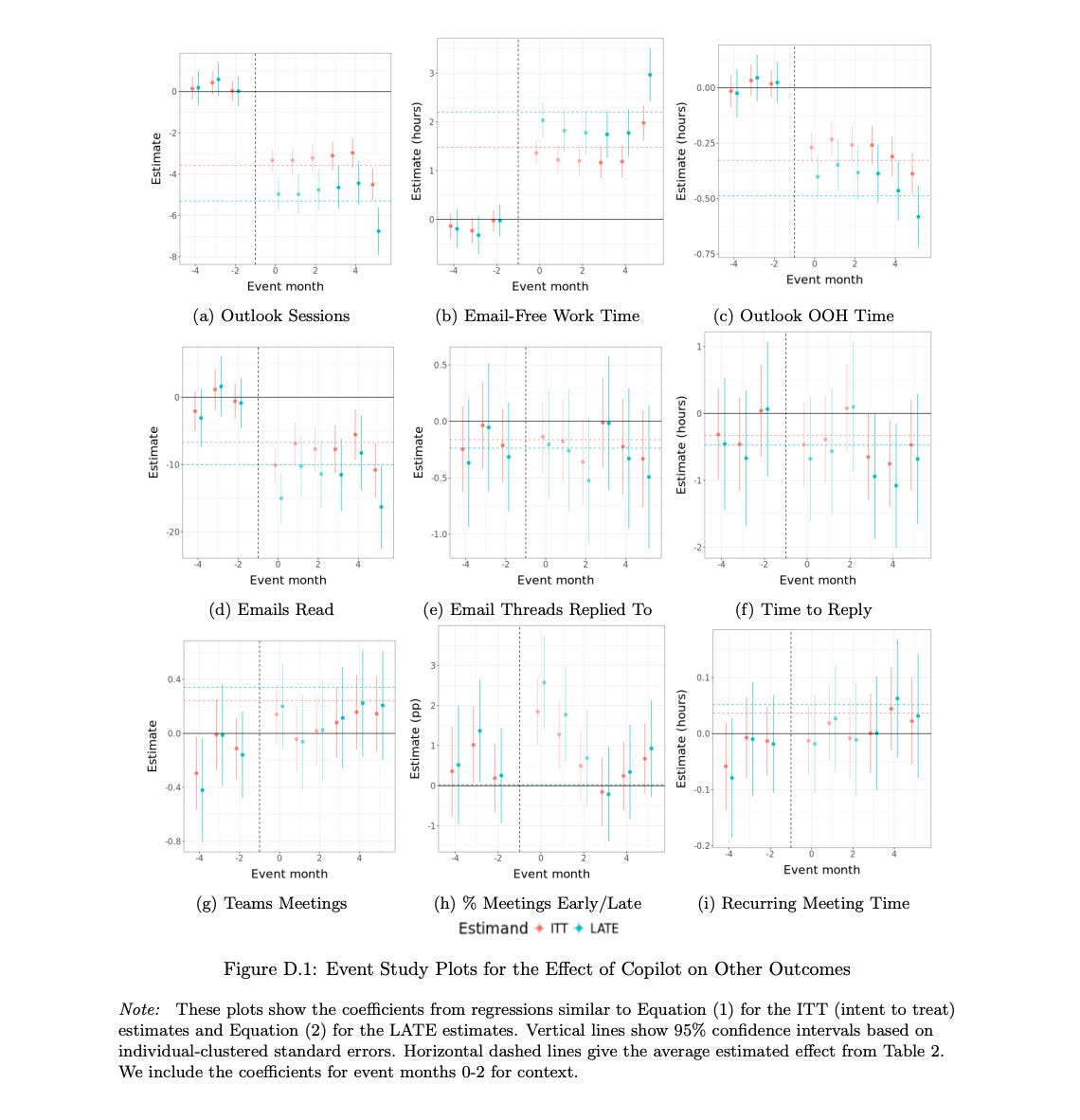
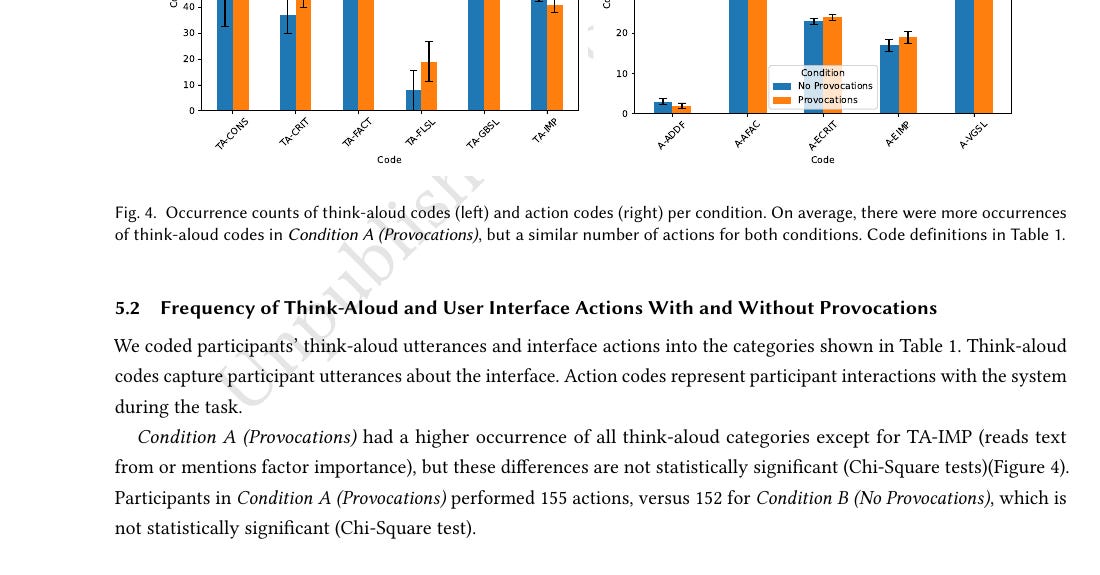
Visual proof: AI changes work patterns
Why the AI machine feels so good
There is a psychological reason this feels so sticky.
AI gives you progress in small, fast doses.
A sentence clicks. An outline stops wobbling. A bug you were avoiding suddenly has a plausible fix without spending hours on Reddit or StackOverflow chasing answers. The pile on your desk doesn’t disappear, but for 30 seconds it looks organized enough to forgive you.
Teresa Amabile and Steven Kramer found that progress in meaningful work is one of the strongest drivers of positive inner work life. AI manufactures that feeling at absurd speed. It doesn’t just help you work. It keeps handing you evidence that work is happening.
And the reward isn’t predictable.
Sometimes the answer is garbage. Sometimes it’s close enough to annoy you. One line or weird punctuation that you catch and give Claude the side eye as if it can see you looking at it with scorn.
That variability matters. The dopamine story is less about simple pleasure and more about reward prediction: the brain learning from the gap between what it expected and what it got. AI creates those gaps all day.
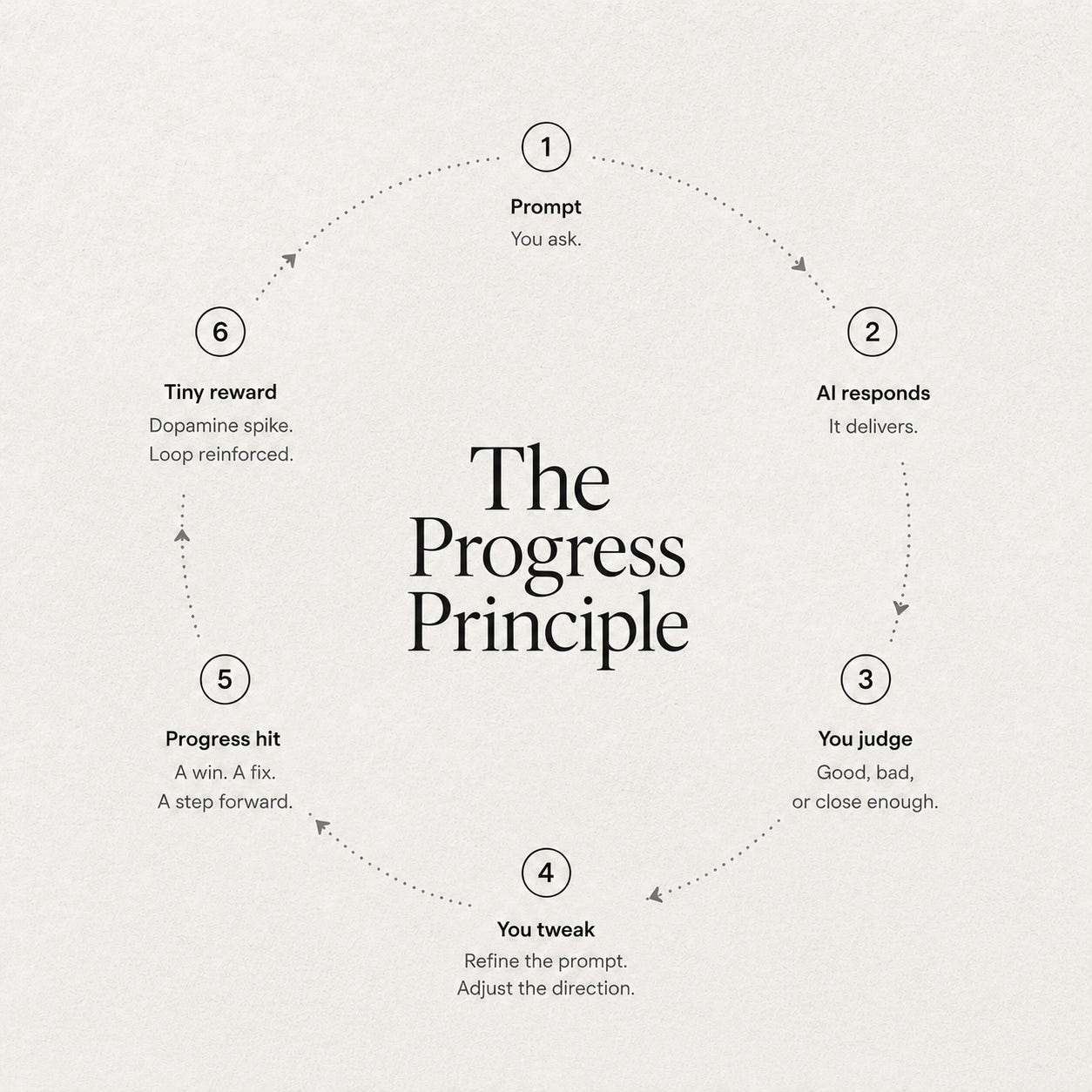
You prompt, wait, judge, tweak. The next run might save the hour. The next branch might be the breakthrough. Or it might send you down the kind of expensive little rabbit hole where someone erases the production database because the grown-up with scar tissue got replaced by a subscription.
Now your work tool has the emotional rhythm of a casino and the costume of productivity. A tiny CEO psyop you run on yourself.
AI removes friction, including the friction that protected us
Friction gets treated like the enemy because a lot of it is.
Bad forms. Slow handoffs. Meetings that exist because nobody wants to write the decision down. Whole afternoons lost to formatting a thing nobody will read twice.
Of course we want less of that.
But some friction was doing important invisible work for us.
The time it took to brief another human forced the idea to become clearer. The cost of asking a designer for another round made you decide whether the round mattered. The pain of building a prototype made you choose which idea deserved to become more than a note in your phone.
AI collapses those costs, and that collapse feels like freedom right up until every impulse starts wearing a little badge that says urgent.
That tiny urgent badge is the whole party trick.
When every idea can have a first draft faster than your standards can get their pants on, the first draft starts asking for a second.
When every product thought can become a spec, the spec starts lobbying for a roadmap. So now your taste has to work harder because polish no longer proves much.
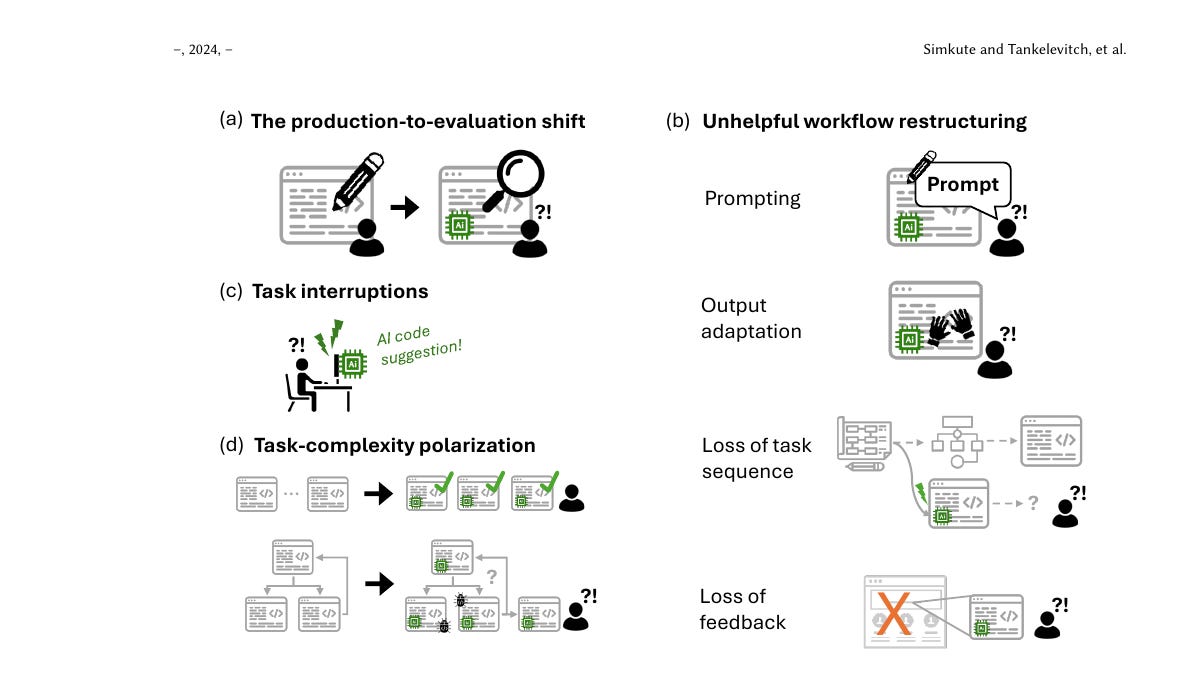
Visual proof: The ironies of generative AI
Your old team has now become a software subscription
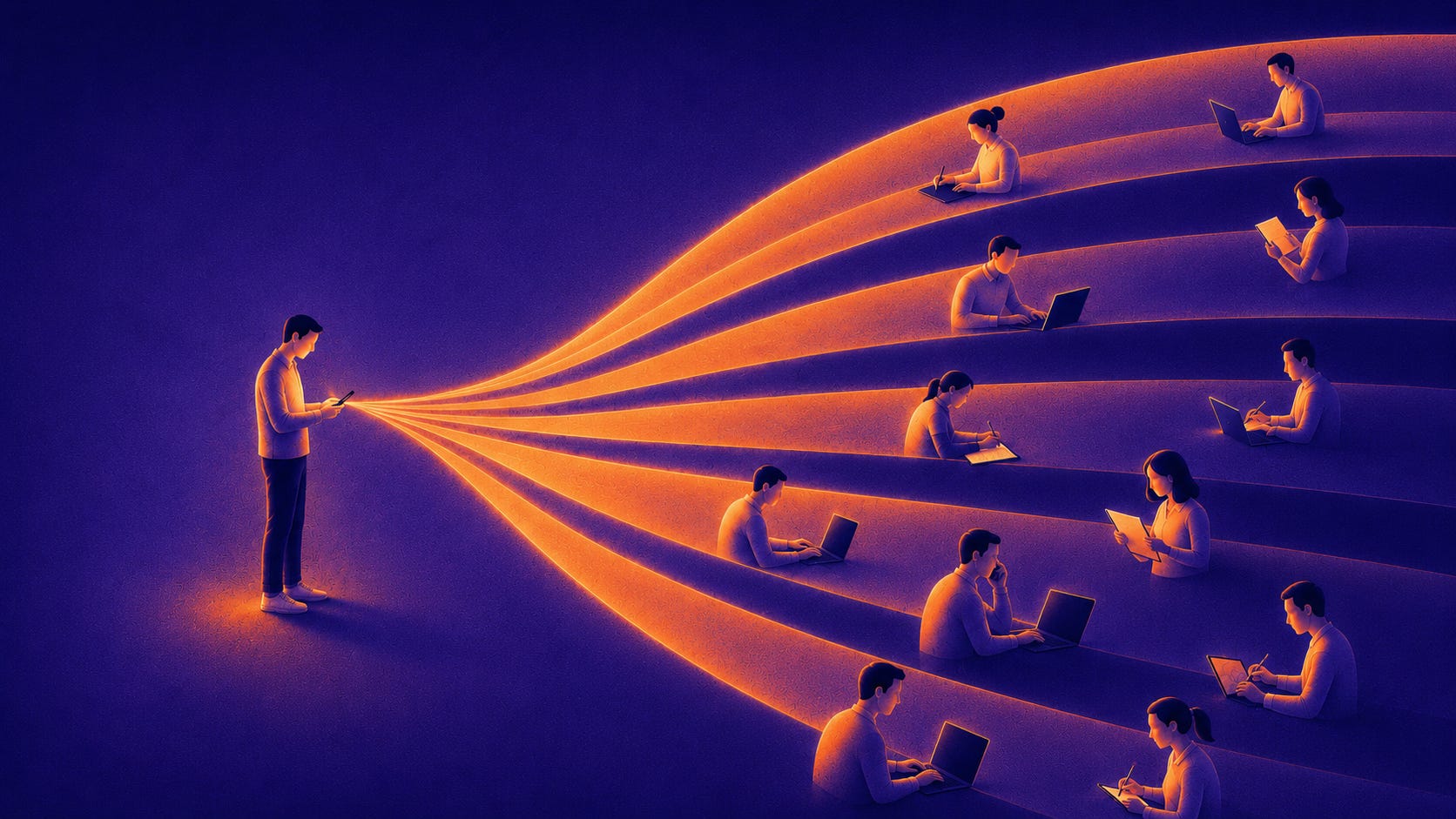
This is the part that still feels a little obscene to say out loud.
For a few subscriptions a month (and a shitload of tokens), I can simulate pieces of a team that used to require salary, management, meetings, context transfer, and the emotional cost of asking another human to care about my half-baked ideas.
The simulation isn’t the same as a great human team. It has no taste until I lend it taste. It has no judgment until I give it standards. It has no real accountability unless I build the accountability around it.
But it’s good enough to change the emotional math.
The old bottleneck was simple: do we have the team for this?
The new bottleneck is weirder: do I have enough attention to supervise all the synthetic help I can summon?
That’s the chart I would put on the wall. Labor used to slow me down. Now judgment has to. And judgment is more annoying because you can’t delegate it without risking abdication.
And if you are a founder, builder, control freak, ADHD brain, creative strategist, or high-agency operator, this is both intoxicating and slightly poisonous. You can finally get the thing in your head into the world.
The problem is that everything in your head now wants a turn.
Working backwards is the brake you’ve been looking for
This is why the lens matters. Most AI sessions start with the tool’s appetite.
What can it make? What can it automate? What can I spin up while I’m waiting for my coffee, sitting in the car, pretending I’m only checking one thing?
That feels practical. It’s also how the machine becomes the center of the room.
Working Backwards changes the order.
Amazon teams have used a strange ritual before building: write the future press release and FAQ first. Not the roadmap. Not the task list. The ending.
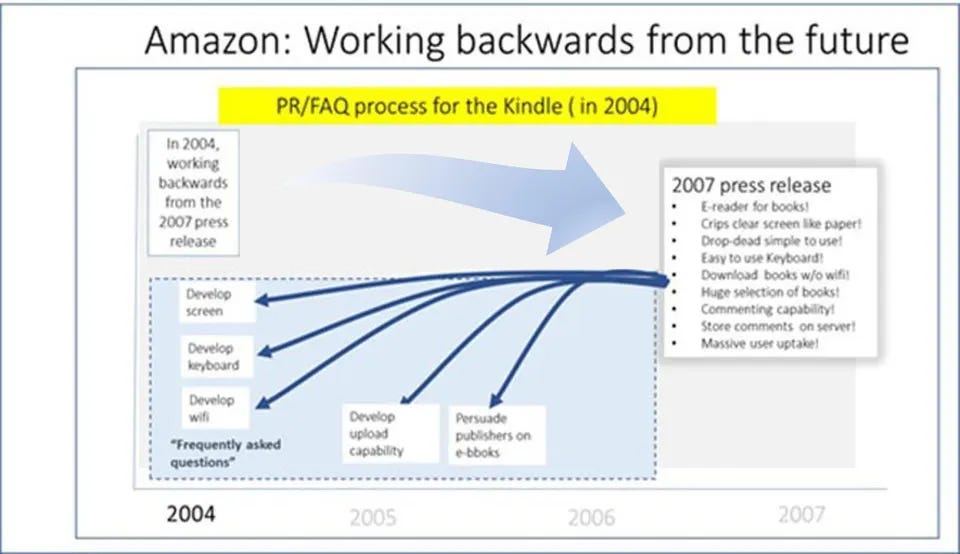
That sounds corporate until you realize how human it is. It forces the idea to walk into the room as if it already happened and answer for itself.
Who changed? What got easier? What fear went away? What would make someone care enough to switch, pay, trust, or tell another human? What breaks if we’re honest? What has to be true before this idea deserves a team, a launch plan, or even an agent run?
The document isn’t the magic. The sequence is. If it was good enough to keep Amazon from building every shiny object that wandered through the room, it’s good enough for those of us now surrounded by machines that can make every shiny object look strangely plausible.
Don’t start with the machine. Start with the future that would make the machine worth using.
Visual proof: The productivity paradox
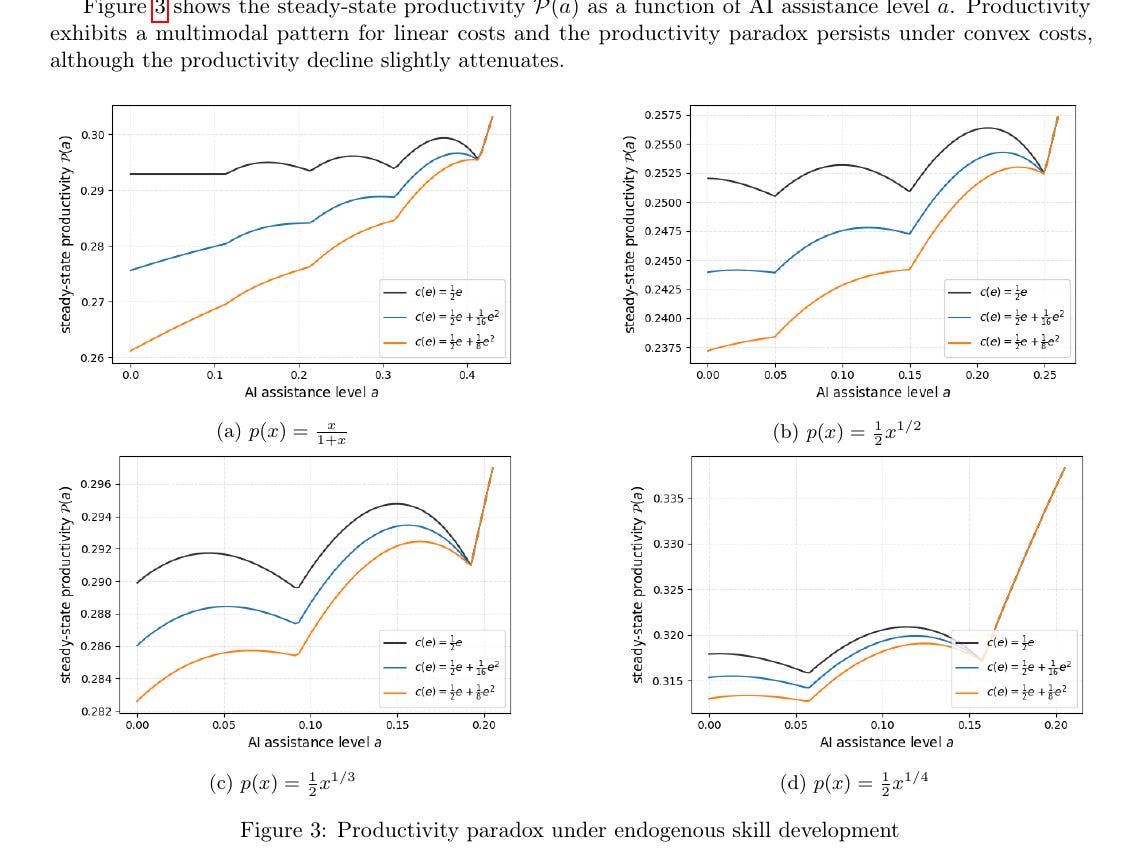
Use AI as a challenger, not a butler
I’m not arguing for some artisanal, anti-AI purity ritual. I use these tools constantly. I build with them, write with them, argue with them, and use them to pull half-formed things out of the fog inside my head. Sometimes they even become money-making machines.
The change is smaller and harder. The nuance is where the magic gets made: stop making the machine your butler before you’ve made it your challenger.
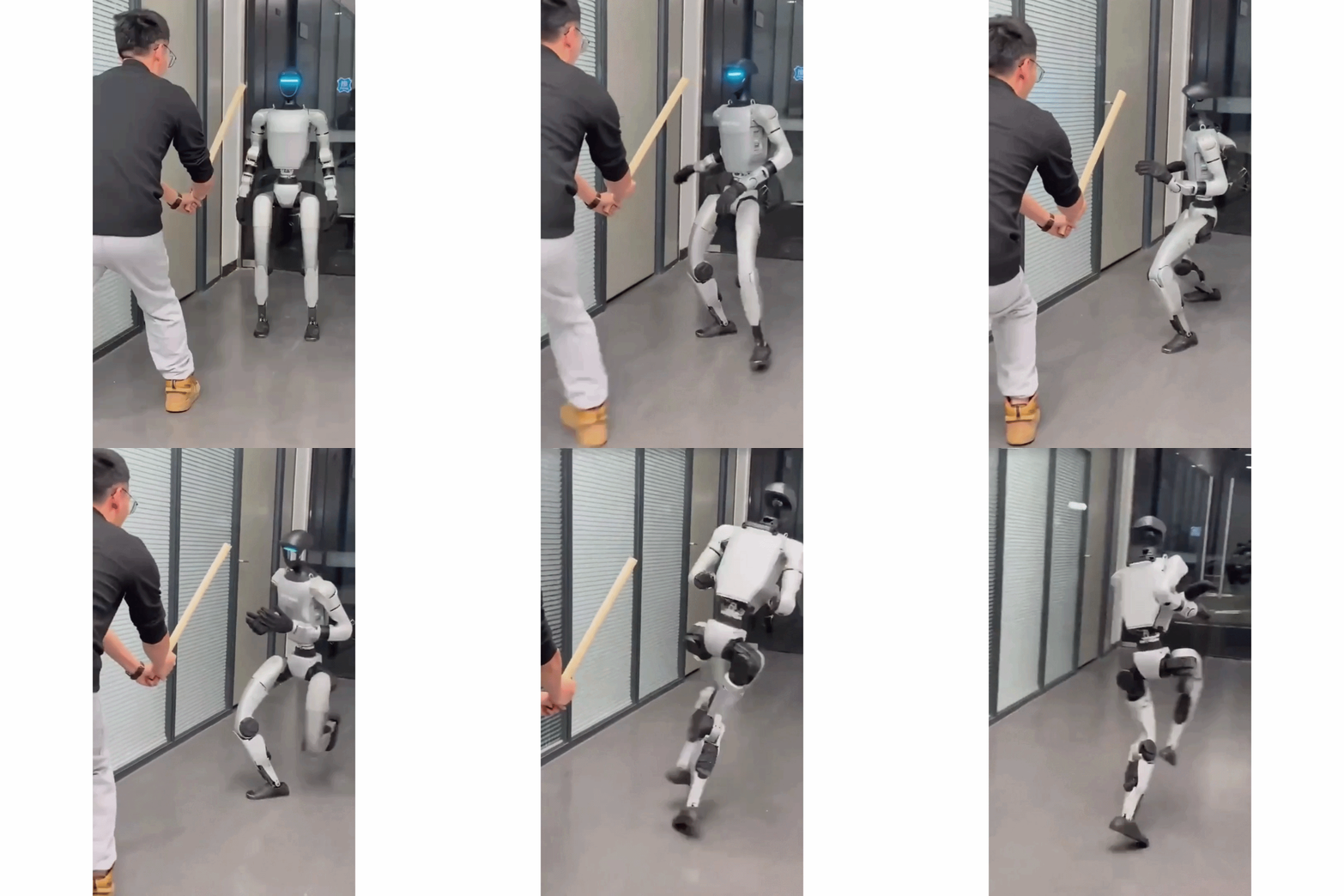
Before you ask it to make the thing, ask yourself whether the thing deserves to exist.
Before you ask it for more options, ask what future would make one option obviously better.
Before you ask it to make something sharper, define what sharpness would actually mean. Sharper for whom? Sharper against what fear? Sharper in service of what decision?
This is the difference between using AI to avoid judgment and using AI to sharpen judgment.
Visual proof: Provocations restore critical thinking
The hungry ghost with a productivity app
Here’s the mirror I want you to feel.
You’re using AI all day and somehow ending the day further behind.
You have more output, but less closure.
You keep opening loops because starting has become almost free.
After a long AI session, you don’t feel rested. You feel bright-eyed and overclocked, like your brain stayed late at the casino and drained your bank account.
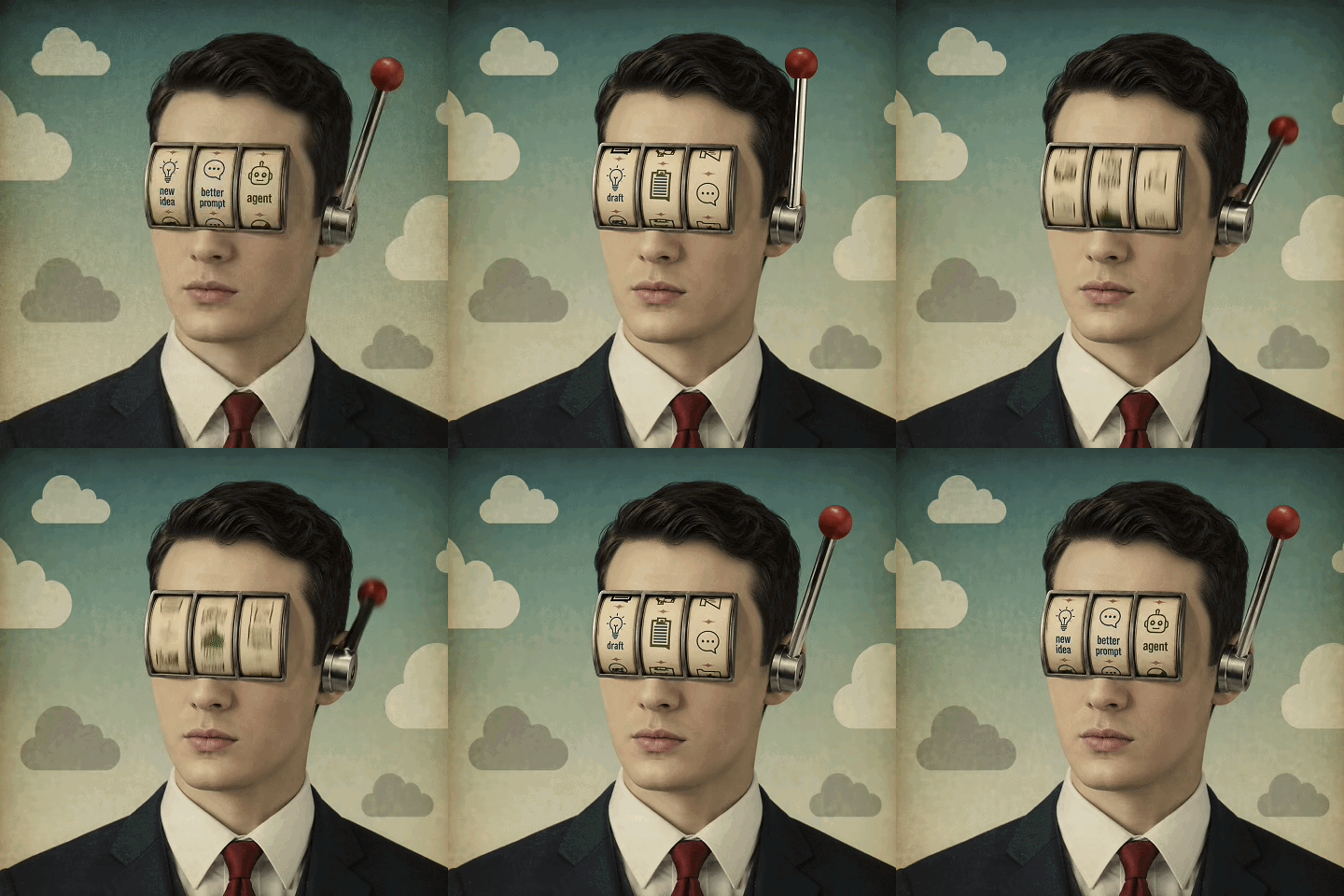
You’re not only asking AI to help you move faster. Sometimes you’re asking it to postpone the moment where you have to choose.
That’s why better prompts, agents, flux capacitors, and Willy Wonka widgets alone won’t save us. We need better stopping rules. We need a way to decide what deserves the machine before the machine makes everything feel deserving.
Before you open your AI slop machine again, do this instead
The lesson isn’t that AI is bad. That would be too easy, and honestly too false.
The next time I feel that little surge, the one that says, just spin up one more agent, just run one more draft, just see what comes back, I want a better question waiting for me.
What future am I trying to make true?
If I can’t answer that, the machine waits.
If I can, then AI becomes leverage instead of appetite with a login.
That is the whole move: decide the ending, then invite the machine.
Steal these prompts before the machine steals your afternoon (and soul)
Prompt 1: The Working Backwards Brake
Don’t create the output yet. First help me work backwards.

Here’s the thing I’m considering:
[describe the product, offer, article, campaign, feature, workflow, or decision]

Before making anything, define the future that would make this worth doing.

Answer in this order:

1. Who is changed by this?
2. What are they struggling with before?
3. What can they do, feel, avoid, trust, or become after?
4. What is the plain-language promise?
5. What would a skeptical customer, teammate, buyer, operator, and critic ask?
6. What has to be true for this to work?
7. Is this worth building, writing, sending, or automating yet?
8. What is the smallest next test?

Be direct. Don’t flatter the idea. Challenge my original thinking before helping me produce the artifact.
Prompt 2: The Productive Compulsion Audit
I’m using AI on this workstream:
[describe workstream]

Help me identify where AI is expanding the work instead of reducing it.

Look for:
- new loops created
- unnecessary second drafts
- tasks that feel easy but don’t matter
- places where I’m using AI to avoid choosing
- outputs that create review burden
- missing stopping rules

Then give me three rules for when to stop.
Prompt 3: The Friction Filter
I want to remove friction from this workflow:
[describe workflow]

Before suggesting automation, separate the friction into three categories:
1. Waste friction that should be removed
2. Judgment friction that protects quality
3. Relationship friction that creates alignment

Then tell me what AI should automate, what humans should keep, and what should happen before the machine starts.
Try the Working Backwards lens
If you want to try the lens on a real idea, use my free Working Backwards tool. It walks you through the Amazon-style press release, FAQ, verdict, and PRD sequence before you let AI start multiplying the work:
