
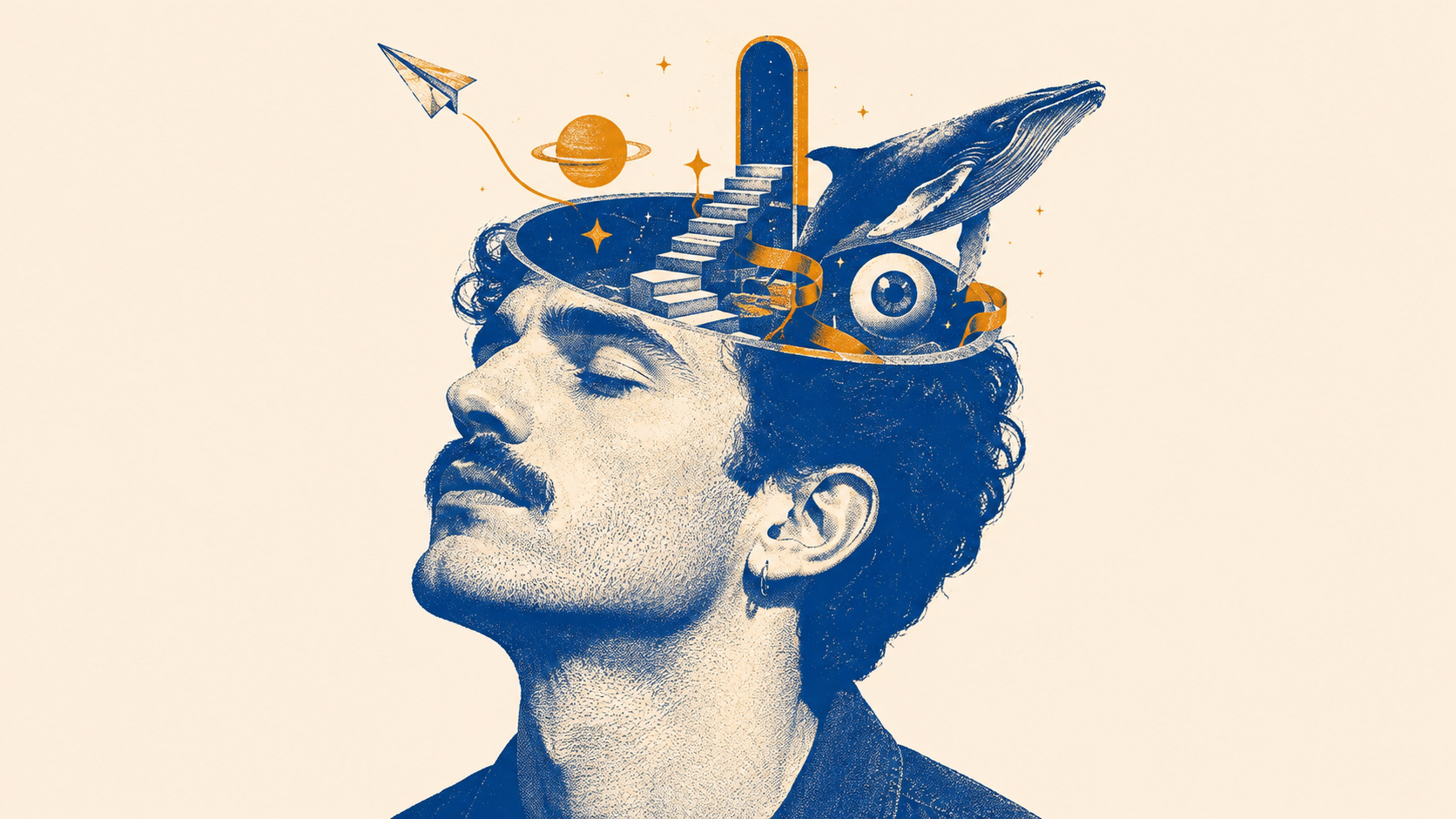
I was on a plane watching a kid in the row ahead of me operate his phone like a slot machine.
Instagram. TikTok. Messages. Back to Instagram. His thumb moved so fast I couldn’t tell whether he was looking for something or trying to outrun it. The phone was very close to his face.
Just when I started to drop into a trance and zone out I see the warning screen pop up on his phone:
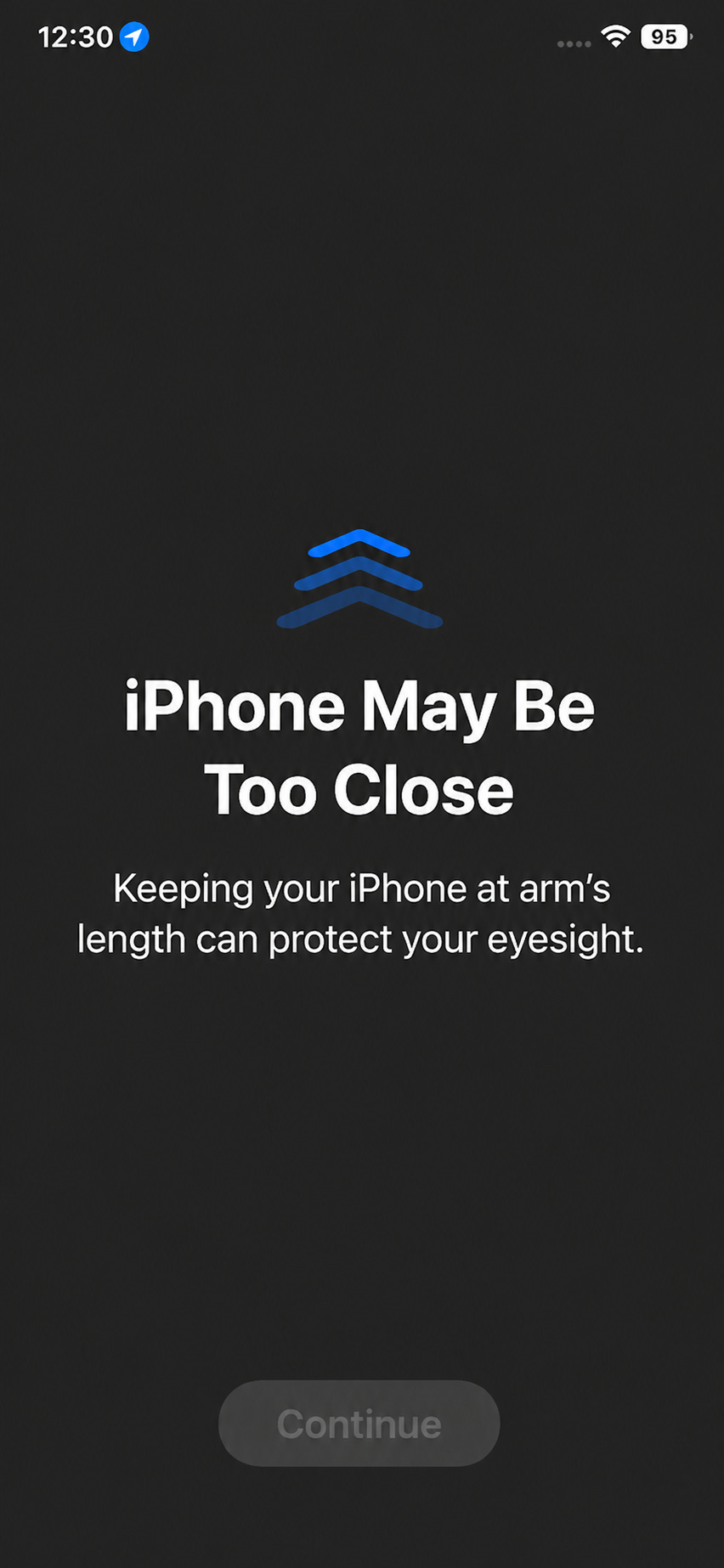
iPhone may be too close.
He pulled his phone away just far enough to close the warning and then went right back to doomscrolling. That warning stuck with me for a while.
His phone could tell when the screen was too close to his eyes, and somehow it had no idea when his feed was getting too close to his thinking.
Back in June, I wrote that AI is making smart people dull. I was writing about atrophy. I kept thinking about the other side of it: what are we supposed to train?
We live inside systems trained to give us more of what already held our attention. Spotify learns the songs we finish. TikTok studies what keeps us from swiping. Amazon predicts the next thing we might buy. Netflix rarely wants to surprise us enough to make us leave.
Now we have generative AI in the same loop. Any of us can ask ChatGPT, Claude, Gemini or whatever launches next week for a hundred ideas before the flight attendant reaches our row with the drink cart.
It feels like abundance. Sometimes it is.
But when we have more answers than we have time to form good questions, we inherit another problem.
And the output is getting more boring and lame. Same LinkedIn posts, same business ideas, the same five talking points rewritten 400 ways. People are flinging beautifully formatted word salad slop into every Slack channel and shared drive. There is a homogenized layer of lame settling over the internet, and the AI slop and AI sprawl are driving me a little insane.
The machines will never be less capable than they are today. What scares me is how capable they already are—and how predictable we’re becoming every day.
Claudefishing is only half the problem
In July, Substack launched an AI-text scanner and Chris Best gave the behavior it was built to expose a name: Claudefishing. A reader thinks there is a person on the other end of the words.
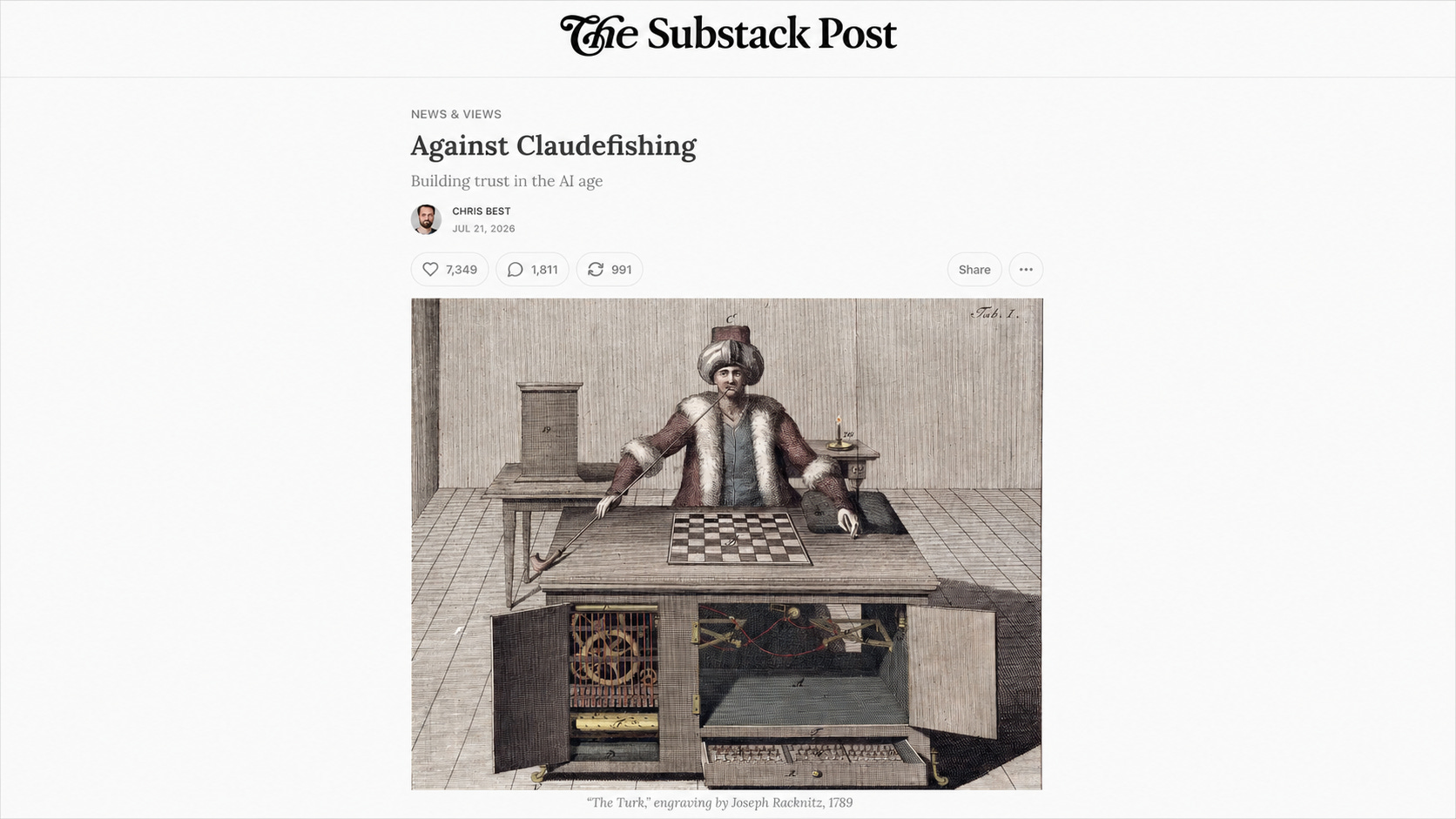
In reality, nobody did much thinking at all.
In August, Anthropic announced that future Claude models will watermark their text. The mark will be invisible to readers, but detectable with the right key.
I understand why both companies are doing it. Authorship matters. Trust matters. If I am asking you to pay attention to my words, you deserve to know whether I stood behind them or rented them by the token.
The scanner still can’t answer the question I care about most: Did a human see anything before the machine started writing?
You can disclose every tool, label every output and still publish a beautifully formatted pile of lame nothings. You can also use AI all day and produce something that could only have come through your particular mix of experience, curiosity, bad decisions, taste, scars and weird obsessions. The dividing line is what the human imagined before, during and after using the tool.
The price of intelligence collapsed
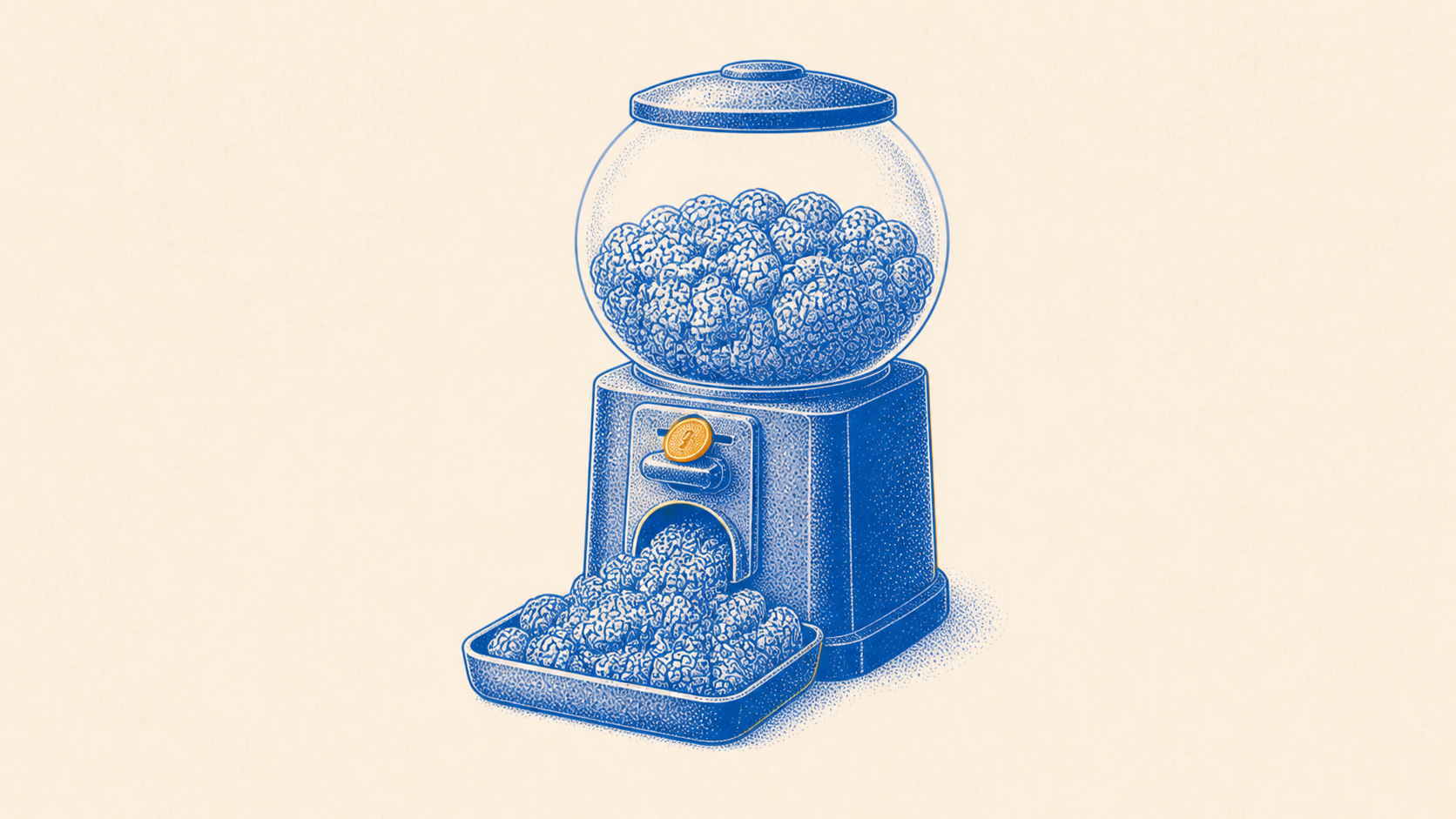
For most of history, intelligence was expensive to access.
Research took time. Analysis lived inside specialized people. A small company couldn’t put a strategist, researcher, analyst, copywriter and software developer to work on the same problem without spending serious time and money. Now some version of that team lives in a browser tab for the price of a streaming subscription.
Stanford’s 2026 AI Index found that the leading models are clustering closer together in capability while consumer access remains free or close to it. The 2025 report found that the cost of running a model at roughly GPT-3.5 performance had fallen more than 280-fold in less than two years.
Routine thinking and cognitive output are basically free at this point for machines. That change is where the premium needs to go, in my opinion.
Intelligence helps solve a problem you can name. Imagination notices that the name itself may be trapping you. It lets you see patterns, possibilities and futures that do not exist yet. It finds a door in a wall everybody else has accepted as load-bearing.
Ann Pendleton-Jullian, the architect and educator who wrote Pragmatic Imagination with John Seely Brown, describes imagination as the capacity to “see not only what is, but what could be” and to “discover unknown, undiscovered unknowns”. She treats it as something practical. A muscle for finding what we have not learned how to look for.
The longer version of that quote moves me closer to tears. It feels like a rallying cry in my nervous system. Creativity gets reduced to brainstorming, aesthetics or making a campaign look cooler. The part I care about goes much deeper. Imagination changes what becomes visible before anybody starts making.
That is why I have started thinking about AI as applied imagination. I got so obsessed with it I made an entire visual essay about it.
Are LLMS rotting our brains?
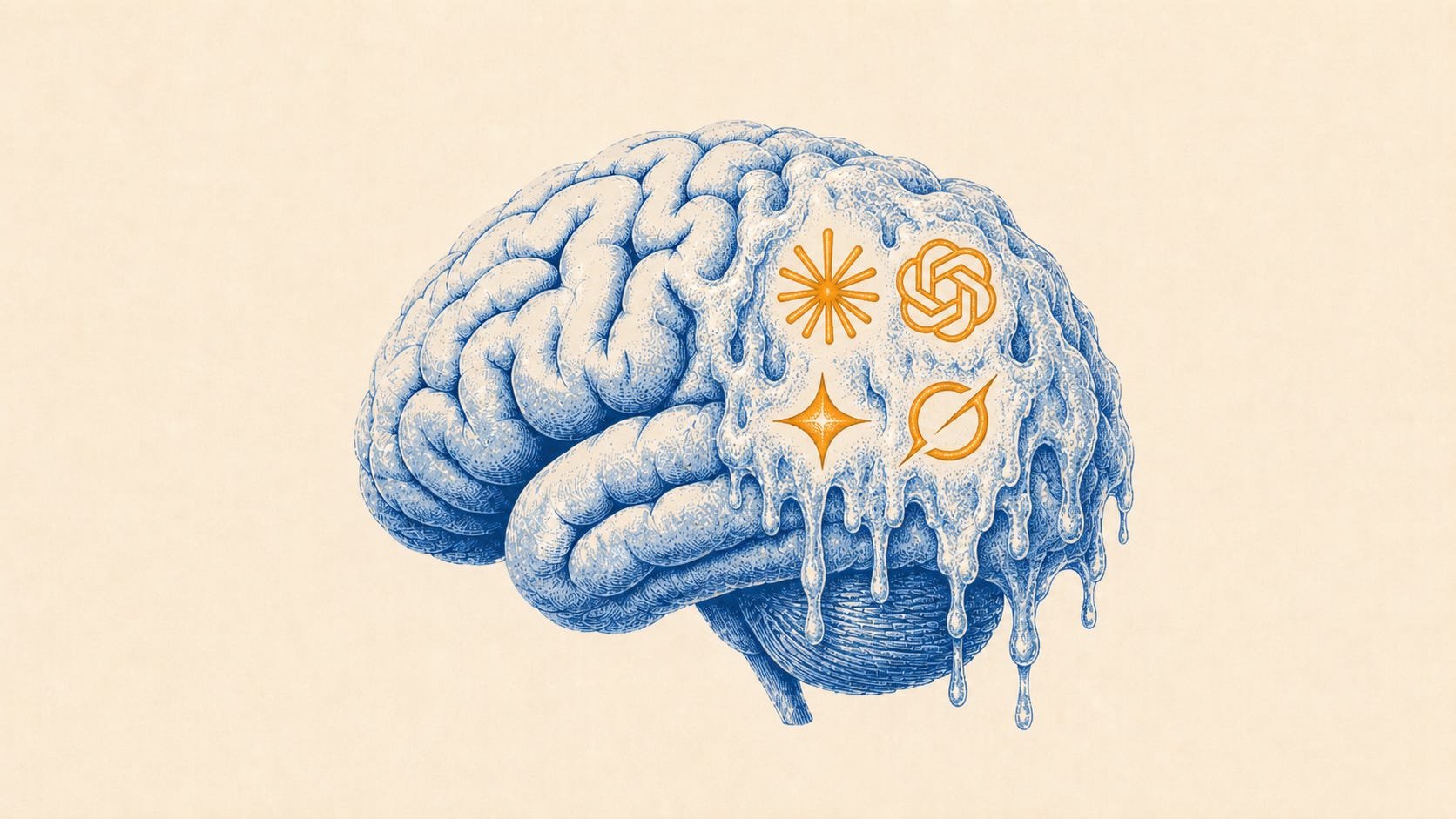
That is the tabloid version of the question, so I went looking for something better than a gut feel.
The study with the irresistible headline came out of MIT Media Lab in 2025: Your Brain on ChatGPT. Researchers split 54 people into three essay-writing groups. One used an LLM, one used search and one had to use the technology between their ears. They measured brain activity with EEG.
The LLM group showed the weakest neural connectivity. They reported less ownership of what they wrote and had more trouble quoting their own essays. The researchers called the potential buildup “cognitive debt,” which is a wonderfully academic way of saying the bill for easy thinking may arrive later.
Cue the brain-rot headlines.
Pump the brakes. The MIT paper is a preprint, not a peer-reviewed verdict. Only 18 people completed its final crossover session, and a later technical critique raised real questions about the sample, study design, reproducibility and EEG analysis. It does not prove ChatGPT causes brain damage. It does suggest that when the machine does the first thinking, less of you may show up in the memory, effort and ownership of the work.
The stronger evidence is less cinematic and more useful.
In 2025, researchers at the University of Pennsylvania ran a randomized field experiment with nearly 1,000 high school math students. Students using a standard GPT-4 interface performed 48 percent better during practice. Then the researchers took the tool away. On the unassisted exam, those students scored 17 percent worse than students who never had it.
The tool made them look smarter while it was in the room and left them less capable when it walked out.
There was a better version. A guarded AI tutor gave hints instead of coughing up answers. Practice scores rose 127 percent, and the damage to unaided performance was largely erased. The researchers watched the ordinary GPT group use AI as a “crutch.” The guarded group had to keep doing some of the lifting.
That is the whole game. Performance and learning are not the same thing. AI can help you finish today’s work while starving the skill that tomorrow’s work will require.
Adults appear to be making a similar trade at work. A 2025 CHI study surveyed 319 knowledge workers and collected 936 real examples of AI-assisted tasks. Higher confidence in AI was associated with less critical thinking. Higher confidence in one’s own abilities was associated with more. This was self-reported behavior, not a brain scan, but the pattern is familiar: the people who hand over judgment soonest tend to inspect the answer least.
The researchers describe a move “from task execution to oversight”. That sounds like an upgrade until you notice what can disappear in the handoff. Oversight may catch a bad answer. It cannot recover a thought you never formed.
These studies do not prove permanent brain atrophy. They give us something more actionable than a scary MRI headline. If the machine always takes the first rep, the skills underneath stop getting reps at all.
Good answers can block better ones
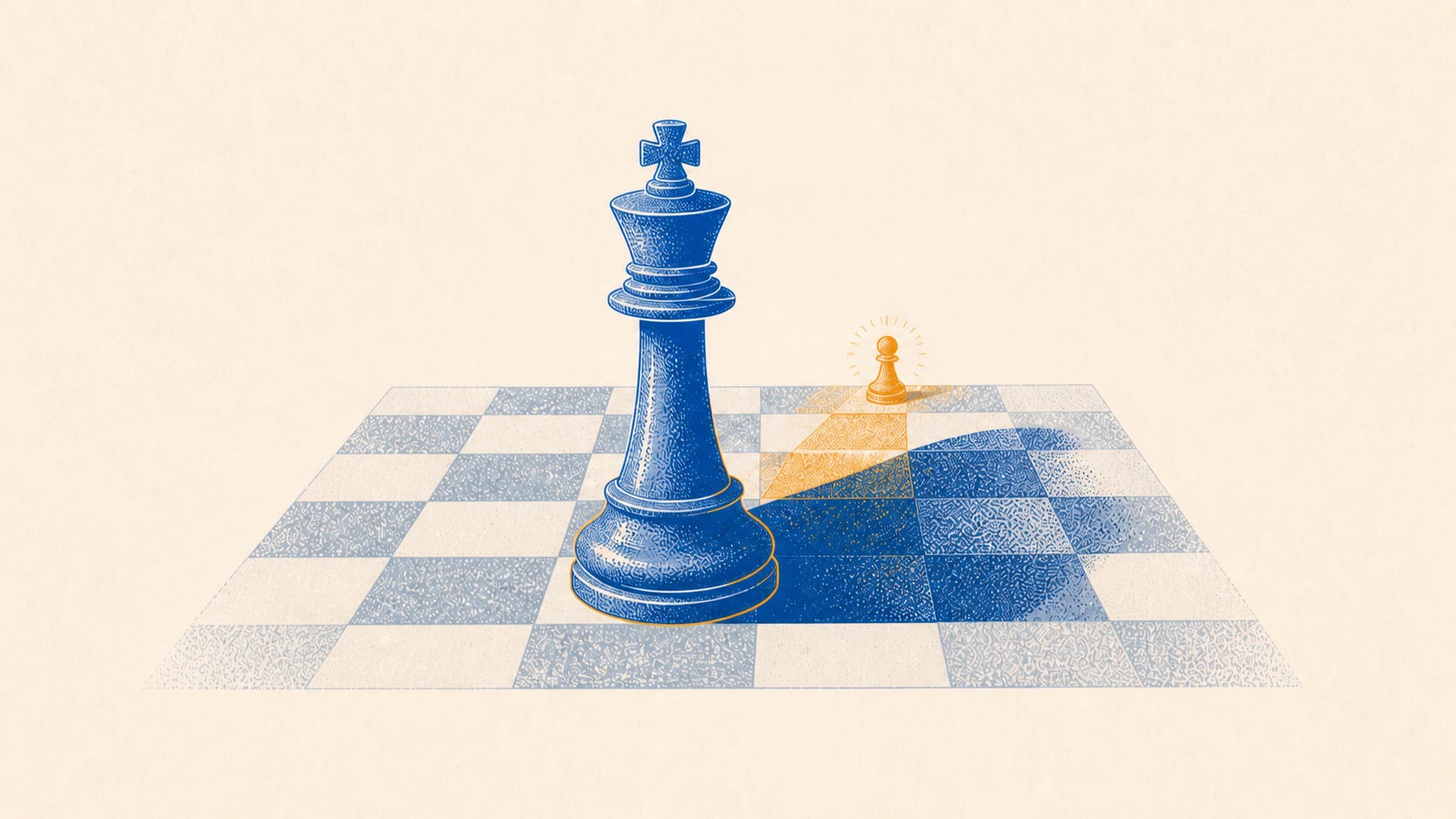
Psychologists call it the Einstellung effect. A familiar solution appears, attention locks onto it and a better solution becomes harder to see.
Researchers Merim Bilalić, Peter McLeod and Fernand Gobet watched this happen with expert chess players. The players were shown a position with a familiar move and a better, less obvious one. Even after they said they were searching for alternatives, their eyes kept returning to the squares involved in the first solution.
The paper’s title is almost the entire warning: Why Good Thoughts Block Better Ones. The first idea occupied their thoughts and directed what they could see. AI can create that condition on demand.
Ask for “the best campaign idea” and a polished answer appears before you have formed a view. Ask it to redesign onboarding and it immediately hands you the same familiar furniture: a welcome email, a checklist, a dashboard, a progress bar. The response feels useful because it is coherent. Coherence is exactly what makes the anchor hard to notice.
The effect has been measured in design work too. In a classic 1991 study, engineering students were asked to design a spill-proof coffee cup. One group saw an example with a straw and mouthpiece. The researchers explicitly pointed out that the example leaked and told the students to avoid those features.
They copied them anyway. The students who saw the example produced far more designs that resembled it than the control group. The bad example narrowed the field, even while sitting there with its flaws labeled.
Think about how most teams use AI. The machine shows the example first. Then the humans react to it. By the time the meeting starts, the field is already smaller.
The moment the room changed
I saw the reverse happen recently with a client.
They are a billion-dollar company that works with some of the biggest brands in the world. I was in a room with people who knew the domain far better than I did, working through a problem that involved AI, data and human behavior.
They were smart. They had the architecture, the inputs, the outputs and the data sources. They were moving through the problem exactly the way experts are trained to move through a problem.
And they were trapped inside it. I was the outsider, which gave me permission to be a little annoying. I started asking questions that did not seem to belong in the room.
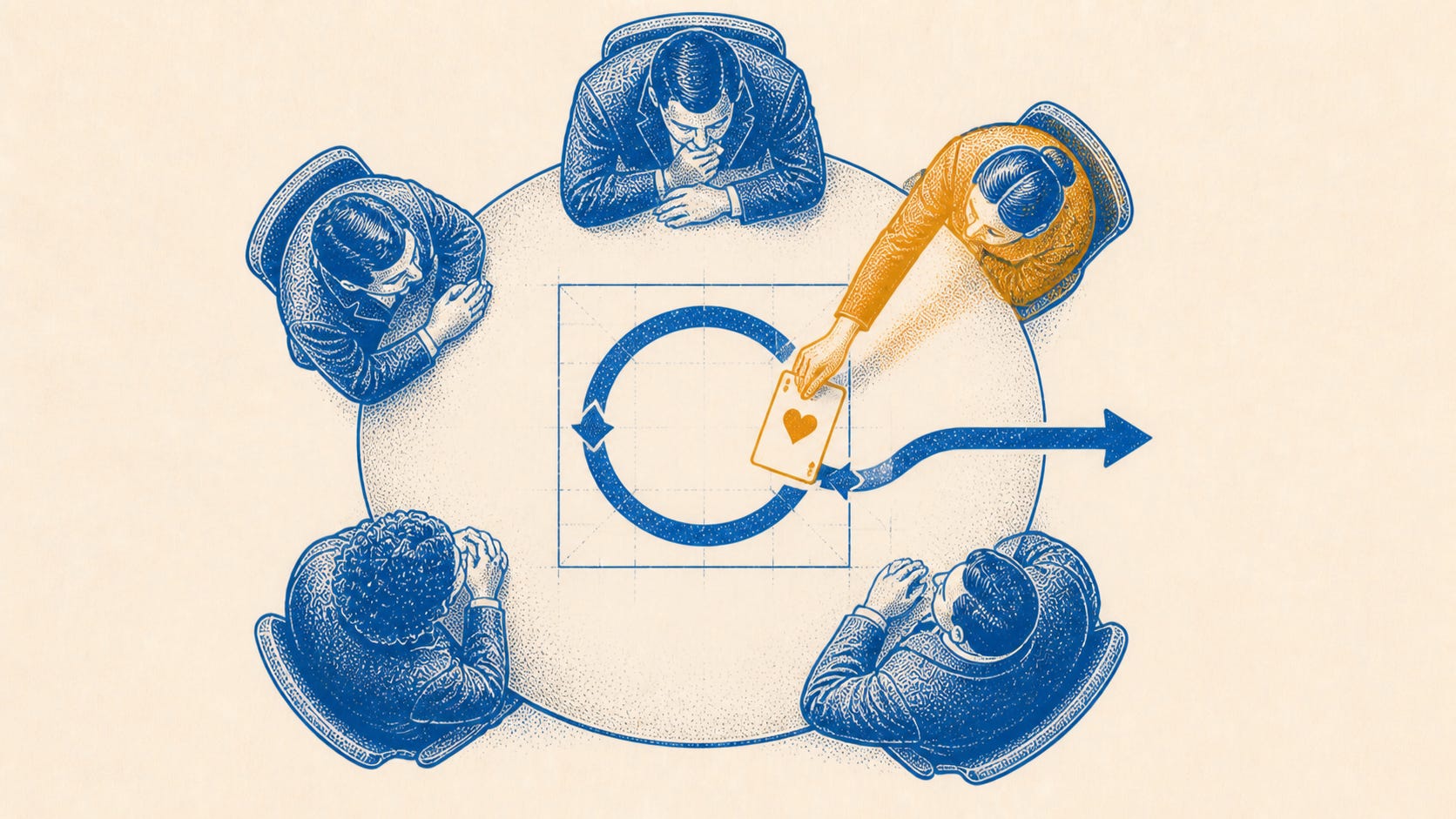
What does this look like through the psychology of a dating app? What could a card game teach us about the interaction? Where is the tension a behavioral scientist would notice? What would happen if we treated the experience like entertainment instead of enterprise software?
I got the side-eye. Fair. They thought I was the weirdo, and they were right. The world needs more weirdos. Then somebody stopped and said, “Wait. Maybe we could try that.”
The room changed. People stopped explaining the system we already had and started leaning into a system that did not exist yet. New questions appeared. The shape of the problem moved.
That tiny moment is why I do this work. It is why I write this newsletter. I did not know more than the experts. I helped the room access knowledge it already had from a different direction. There is research behind that move.
In a set of experiments published in Cognitive Psychology, Mary Gick and Keith Holyoak gave people a difficult medical problem. A doctor needed to destroy a tumor with radiation without damaging the healthy tissue around it. Only about 10 percent found the convergence solution on their own.
Another group read a military story with the same hidden structure: a general divides an army into smaller groups and approaches a fortress from several directions at once. Without being told that the story mattered, roughly 30 percent transferred the idea. When researchers gave a simple hint to connect the two problems, the solution rate jumped to 75 percent.
The knowledge was available. They did not need a smarter doctor. They needed a story from somewhere else to change the shape of the problem. Crossing the distance between two things that look unrelated is imagination at work.
Use AI to widen your creative aperture
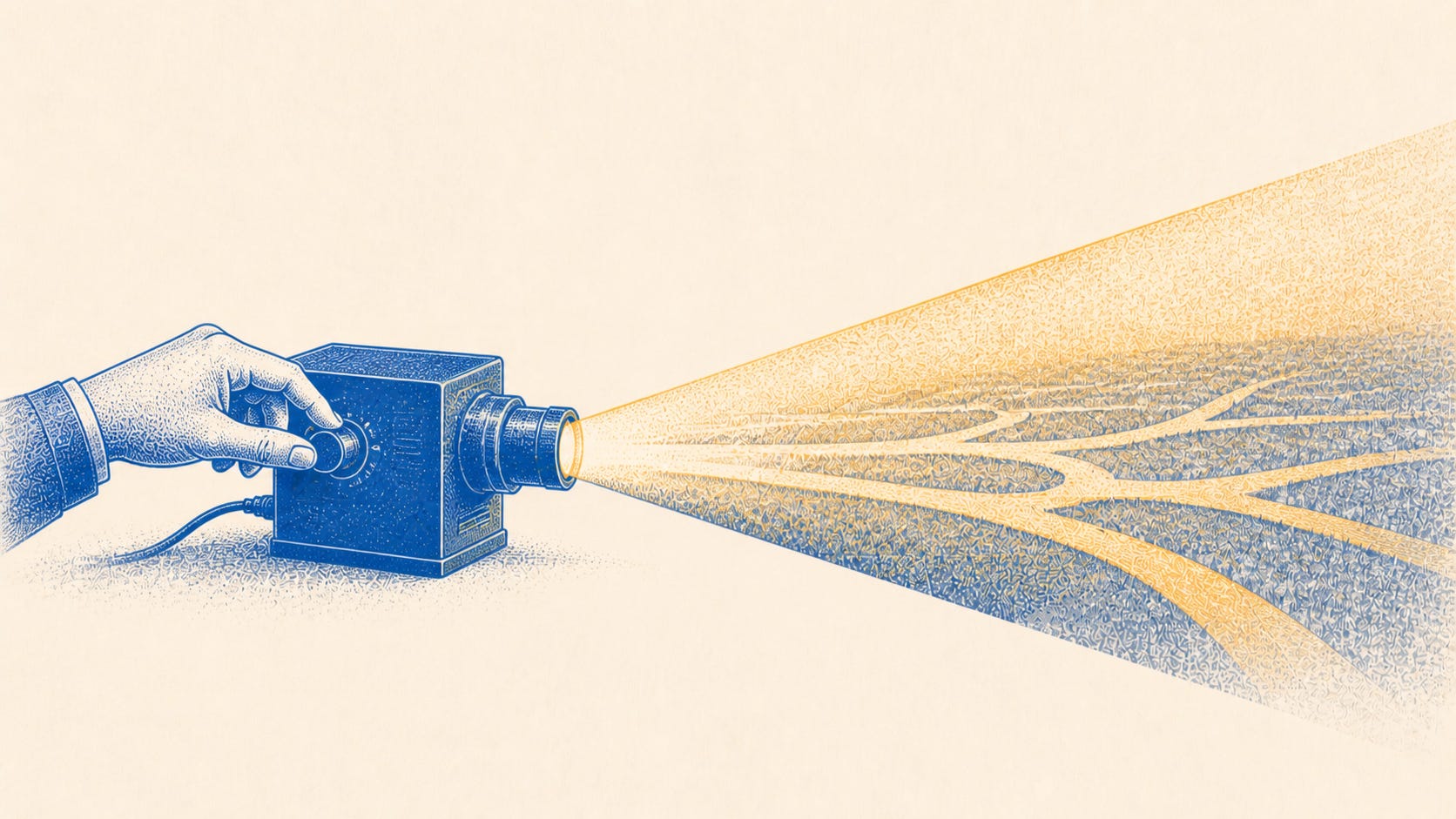
The usual AI workflow does the opposite. We describe the problem once, inside our current assumptions, and ask the model to solve what we just handed it. The model becomes an answering machine for our existing frame.
I have been testing a different sequence. The answer comes later. First, I use the machine to attack the shape of the problem.
