


Someone in your family dies.
The world doesn’t skip a beat. It just hands you a checklist of new shit to do.
Flights. Family calls. Death certificates. Dates. The grief is real, but the logistics get there first. You move through all of it in a fog because somebody has to.
Airline policy is the last thing you have the energy to think about.
So when Jake Moffatt’s grandmother died, he did what millions of us now do.
He asked the system.
He opened Air Canada’s website. The fancy AI chatbot told him he could book a flight, travel, and apply for a bereavement discount within ninety days. The answer was calm and more confident than a tech bro after three espressos at Philz.
It appeared on the company’s website. Why wouldn’t he trust it?
Moffatt booked the ticket and took the trip. Air Canada later refused the refund.
Then the story got weird.
Air Canada argued that it should not be responsible for the chatbot’s answer. The British Columbia Civil Resolution Tribunal said the argument amounted to treating the chatbot like a separate legal entity responsible for its own words.
The tribunal wasn’t buying it.
The chatbot was sitting on Air Canada’s website, speaking to an Air Canada customer about an Air Canada policy. The company owned the answer, even though the answer was wrong.
Moffatt received 650.88 CAD in damages, plus interest and fees. The money barely matters. The useful part of the case is the sentence now slipping into meetings everywhere:
The AI recommended it.
Those four words sound harmless. They describe where an idea came from. They also move responsibility out of the room.
Used often enough, they become an alibi.
People are making mistakes left and right because we’re getting intellectually lazy. The machine gives us something clean, confident and plausible. We move it into the next meeting before anybody has wrestled with the thought.
I think we’re becoming intellectually bulimic.
We binge on information, skip the digestion and throw up bad thoughts at machine speed. Board decks. Pricing decisions. Performance reviews. Strategy documents. Half-digested ideas wearing nice fonts.
AI didn’t invent bad thinking. It put bad thinking on an assembly line. And it’s not a bug, it’s actually a feature of how the systems are designed. Wanna nerd out on how LLMS works? Here you go
The alibi that lets everyone walk away clean

Inside a company, responsibility rarely disappears all at once.
A model flags a high-performing employee as underperforming because someone used a free HR skill they downloaded on GitHub without actually testing it first. A pricing system suggests a 7% increase. An AI agent drafts the board report and wraps the numbers in charts clean enough to survive a skim, but it made up all the numbers.
Work speeds up. Meetings shrink. The recommendation feels more credible because it arrives formatted and scored.
Then the language softens.
“The system recommended it.”
“The model flagged it.”
“The AI suggested it.”
That wording turns a judgment call into something that feels technical and inevitable. Numbers create distance. A confidence score makes a choice look like a finding. Following the recommendation feels safer than owning the decision.
Then something breaks.
A strong employee gets fired. A loyal customer leaves after the 7% increase. The board report contains a number that looked plausible and turned out to be wrong.
Somebody asks the question everyone should have asked earlier: Who made the call?
By then, ownership has gone missing. People reviewed the output. Someone clicked approve. The work shipped. Nobody can explain who truly decided.
“Nobody” works fine until accountability shows up.
A human in the loop can still be asleep at the wheel

Most companies believe they have covered this problem with a human reviewer. Their checklist asks whether a person looked at the output before it went live.
Someone did. Great.
Looking is cheap. Ownership costs something.
Ask yourself: Which human actually owns the judgment?
That person should be able to explain the decision in plain language. They should know what the system produced, where it could be wrong and why they trusted it in this case. They also need enough authority to pause the work or reject the answer.
A warm body next to an approve button gives you ceremony. It doesn’t give you ownership.
This is where accountability and traceability meet. Accountability puts a name on the call. Traceability lets that person show the source, the AI output, the human judgment and the reason the work shipped.
A wrong answer can be corrected. A decision with no chain of custody becomes a board problem, an audit problem, or a lawsuit.
Sometimes you get the combo meal.
AI makes weak thinking look finished
The alibi usually starts with convenience.
“The AI drafted it.”
A proposal that took three hours now takes five minutes. A dense report becomes a clean summary that skips the meat that only a human brain with real wisdom can see. A junior employee produces something that looks senior enough to pass at a glance.
That last part is dangerous. When an output looks finished, people treat it as finished.
You skim language you didn’t write. You trust a chart you didn’t build. The model’s confidence starts replacing your own scrutiny.
Spreadsheet mistakes often look suspicious.
They have headings, clean labels and a chart that seems to know what it’s talking about. Polish becomes camouflage.
We’ve been doing a lot of work lately helping finance and business teams adopt AI to reimagine their work. One thing people don’t understand about finance is this:
If you’re 95% right, you’re 100% out of a job.
I recently read that at one company (not my clients), AI-generated board reports carried incorrect data for an entire quarter. The reports looked finished. The charts were clean. The analytics sounded confident.
One small problem. The numbers were absolutely wrong.
A pretty chart with a bad number is just a confident lie in brand colors.
Once that number lands in a board deck, nobody cares that the model hallucinated. They want to know where the number came from, who checked it and why it stayed wrong for three months.
Nobody has ever saved a board meeting by saying, “To be fair, the AI sounded extremely confident.”
The model produced the error. The workflow waved it through.
Everybody touched it. Nobody owned it.
The decision exists. The trail is missing.
A June 2025 Resume Builder survey asked 1,342 U.S. managers how they were using AI. Among managers who used it for people decisions, 78% used it for raises, 77% for promotions, 66% for layoffs and 64% for terminations.
More than one in five said they often or always allowed AI to make final decisions without human input. Only 32% had received formal training.
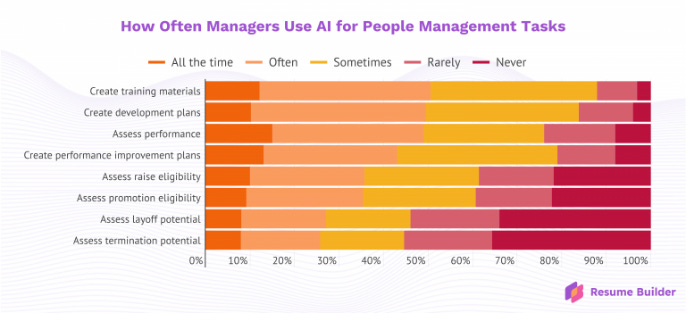
This was a commercial survey, not a peer-reviewed study. I wouldn’t treat it like scripture. I would treat it like a smoke alarm.
General-purpose AI tools are already sitting inside decisions that change people’s lives. Most companies haven’t built a decision trail to match.
That gap landed in federal court this month.
Twenty-six Meta employees alleged that internal AI-assisted systems helped select workers for layoffs and disadvantaged people who had taken medical or family leave. Meta denied the claim and said humans made every layoff decision.
On July 17, 2026, a federal judge declined to pause the layoffs. He said the plaintiffs lacked evidence showing whether and how AI had been used improperly. Reuters captured the bind on July 22. The workers were not in the rooms where the decisions happened. Their lawyers said Meta held nearly all the relevant information.
The company says humans decided. The people affected can’t see how. The evidence lives inside systems they don’t control.
The decision exists. The trail is missing.
The machine has better paperwork
There is another reason people follow the model. It shows up with receipts.
Your best operator has spent fifteen years learning which deals go bad. She hears a pitch and catches something small. The buyer’s urgency doesn’t fit the budget. The room goes quiet at the wrong moment. Something smells off.
She says, “I don’t like this deal.”
The model arrives with a risk score, contributing factors, a confidence interval, and a recommendation.
One person has fifteen years of scars. The machine has a deck.
A 2024 working paper by Hossein Nikpayam, Mirko Kremer and Francis de Véricourt found that people making delegated decisions were more likely to follow an algorithm to protect themselves from blame. As of June 2026, the paper was still under review at Management Science. That makes it a useful signal, not settled science.
The behavior will still feel familiar to anyone who has survived a corporate meeting. A bad decision with documentation is easier to defend than a good decision built on judgment you can’t explain.
The machine leaves timestamps, scores and neat little boxes. Experienced human judgment often lives inside someone’s head.
The model wins because it filed the paperwork.
Companies need to capture the human judgment too. Ask the operator what felt wrong. Write down the pattern she recognized. Record why she overrode the score.
Otherwise, your best judgment disappears while the machine’s worst judgment gets archived.
Someone still absorbs the impact
Researcher Madeleine Clare Elish coined the term “moral crumple zone” for the human who absorbs blame when an automated system fails, even though that person had limited control over it.
You can see how this plays out inside a company.
A senior leader approves the system. An analyst uses it inside a workflow they didn’t design. The system helps produce a bad decision. The analyst clicked approve, so the blame rolls downhill.
The executive keeps the alibi. The analyst gets the wreckage.
Putting a name on a decision works only when that person has enough context to understand it and enough power to reject it.
A name without authority is theater.
If you touch it with AI, you own it

I build AI systems for a living. I want teams using them. I want the hours back and the better work that can come with them.
I also know what happens when speed outruns ownership.
At my companies, we introduced a simple rule:
If you touch it with AI, you own it.
The person using AI to write code owned the code. The person building a prototype owned the prototype. Anyone carrying AI-generated analysis into a meeting owned every number on the page.
The rule killed the ghost employee in the room.
“AI” couldn’t own the code. It couldn’t own the forecast. It couldn’t sit in the boardroom and defend a recommendation.
The person carrying the work had to do that.
People slowed down just enough to check assumptions and challenge weak outputs. They stopped treating the model’s answer as pre-approved.
Quality went up because scrutiny did.
Review is a task. Ownership follows you into the room after the decision goes bad.
NIST’s AI Risk Management Framework uses formal language about roles, oversight and accountability. The operating rule can stay plain: put one name on the decision.
Run the five-minute replay test
Take one meaningful decision your company made with AI in the room. Use a hire, a forecast, a pricing change or a board recommendation.
Put this block at the top of the document:
Decision:
AI contribution:
Source data:
Human judgment:
Owner:
Reason for approval:
Override trigger:
Ask the owner to replay the decision in five minutes.
Can they show where the information came from? Can they explain what the AI did? Can they point to the moment human judgment entered the process? Can they tell you why they signed off?
Use a person’s name. “Leadership” can’t sit in front of the board. Neither can “marketing,” “finance” or “the AI team.”
Every blank field is a hole you’ll wish you had filled when the number gets challenged.
Three prompts that catch bad AI work before it ships
No prompt makes a model truthful. These three add friction at the moment clean-looking work tries to outrun judgment. Each comes from a method tested in peer-reviewed machine learning research.
The chain-of-verification prompt
Chain of Verification, usually shortened to CoVe, forces the model to draft verification questions,, answer them independently and revise the original response. Researchers reported fewer hallucinations across list questions, closed-book question answering and long-form generation.
Use this after the first answer. A fresh chat is better because the model is less likely to defend its original wording.
Audit the answer below using Chain of Verification.

1. Extract every factual claim, number, date, named entity and causal claim.
2. Write the questions that would expose each claim if it were wrong.
3. Answer those verification questions independently. Do not use the original answer as evidence.
4. Check primary sources when browsing is available. Link each source.
5. Label every original claim VERIFIED, CONTRADICTED, UNSUPPORTED or UNCLEAR.
6. Rewrite the answer using only verified claims. Mark anything that still needs human review.

Answer to verify:
[PASTE THE ANSWER]
The important move is independence. “Check your work” often produces a confident rereading of the same mistake. CoVe makes the model build questions that can prove itself wrong.
The cite-it-or-strike-it prompt
RARR stands for Research and Revision. The method searches for evidence, adds attribution and edits unsupported claims while trying to preserve the original answer.
This is the one I would run on a report, strategy memo or article before it leaves the building.
Build a source ledger for the draft below.

Break the draft into atomic factual claims. For each claim, return a table with:

Claim | Best primary source | Exact support | Status | Required change

Use VERIFIED, PARTIAL, CONTRADICTED or UNSUPPORTED for status.

A citation counts only when the source supports the exact claim. Do not use search snippets, another AI summary or a source that merely discusses the same topic.

After the table, revise the draft. Keep verified claims. Fix partial or contradicted claims. Delete unsupported claims unless they are clearly labeled as opinion.

Draft:
[PASTE THE DRAFT]
This catches citation theater. A blue link is not evidence. The page behind it has to support the sentence in front of it.
The prove-it-with-a-tool prompt
The CRITIC method gives the model external feedback from tools such as search, a calculator or code, then asks it to revise. That last part matters. A model grading its own homework from memory is still the same kid holding the answer key.
Use this on forecasts, pricing, analytics and anything headed toward a board deck.
Treat every number and factual claim below as untrusted until checked.

1. List each number, formula, factual claim and source assumption.
2. Recalculate every number with a calculator, spreadsheet or code tool. Do not do arithmetic in prose.
3. Verify factual claims against primary sources.
4. Return a reconciliation table:

Item | Original value or claim | Tool or source used | Verified result | Variance | Owner action

5. Stop and flag any item that cannot be reproduced.
6. Revise the work only after the reconciliation is complete.

Work to check:
[PASTE THE WORK]
The dumbest useful rule in this whole article might be this: make the machine show the math outside the paragraph.
These prompts can lower the error rate. They can’t own the answer.
You still do. So when the board asks where the number came from, the prompt is not your defense.
Research and receipts
Moffatt v. Air Canada, 2024 BCCRT 149, case summary and award details
Reuters report on the Meta employees’ lawsuit, July 22, 2026
Madeleine Clare Elish, “Moral Crumple Zones,” Engaging Science, Technology, and Society, 2019
Nikpayam, Kremer and de Véricourt, “AI-Assisted Decisions in Organizations,” working paper
Excellent piece, Pete. One thought I’d add: AI isn’t creating an accountability problem; it’s exposing one that has always existed. Organisations have long hidden behind consultants, software and process. Today they hide behind prompts and models. The technology has changed, but the psychology hasn’t. Ultimately, the question isn’t whether AI produced the answer. It’s whether a human can still explain, evidence and defend the judgement behind it.
Agreeing with Dr. Swanepoel's comment above... excellent piece here. The true "provenance" behind responsibility and accountability is obfuscated by all the scenarios you outlined (and the legacy approaches relief upon the Doctor noted). In a fast paced/demanding world where it is often a cheaper business expense to ask for forgiveness rather than thoughtfully considered execution to arrive at mutually perceived permissions to act, AI becoming a scapegoat is a fool's game that isn't lasting past the 2nd inning of 9 inning game. The two "Cs" of Convenience and Cost never rang truer