

I’m standing in my backyard, staring at the koi pond that came with my house.
I didn’t buy the pond. I bought the house. The pond was already there, sitting there in the backyard, looking expensive and serene and completely self-sufficient. At least that’s what I thought.
Then I learned that koi ponds have pumps, filters, chemistry, seasonal care, predators, algae, and a person who knows what all of those things mean. There is always a guy. The pond looked like a feature of the property. But what I actually inherited was a small living ecosystem with a maintenance schedule.
A friend of mine had a custom pizza oven built into his patio. Another bought the kind of car that makes grown men lower their voices when they say the model name out loud. Both got exactly what they wanted. They also got the special fuel, the unusual replacement parts, the weird service interval, and the guy you call when the thing you love starts making a noise you don’t understand.
This is the part we leave out when we talk about luxury. We talk about the first drive, first pizza, first summer night next to the pond. We don’t imagine ourselves three months later trying to figure out why the water looks strange and smells like a sewer.
Every luxury needs a mechanic.
And I think a lot of companies are accidentally filling themselves with luxury goods right now.
I love vibe coding. I’ve been building software since I was a kid, and the fact that I can describe an idea to Claude, ChatGPT, Cursor, or whatever comes next and watch a working version appear still feels a little bit like magic. The distance between imagining something and touching it on a screen has collapsed.
For builders and tinkerers, that’s intoxicating. For executives who have spent years trying to explain what they want to product teams, it’s even more powerful. They can finally shape the software around the way they think instead of learning to think like the software.
You can build the dashboard your vendor refuses to give you. You can create a personal CRM that remembers who you met, why they mattered, and the thing you promised to send three weeks ago. You can make a digital chief of staff that lives across your calendar, documents, messages, customer data, and the open loops that normally stay trapped inside your head.
You can build software for one person. And that person can be you.
There’s something beautiful about designing for one. Most commercial software has to survive roadmaps, customer segments, support tickets, compliance reviews, quarterly targets, and the competing needs of thousands or millions of users. Personal software can be strange. It can be particular. It can use your language, follow your habits, and arrange information in the exact order your brain wants it.
That’s why some of the best products started as a founder scratching their own itch. Someone had a problem. The existing tools weren’t good enough. So they built something for themselves and eventually discovered that plenty of other people had the same pain.
This game isn’t new, but the number of people playing it are first-timers.
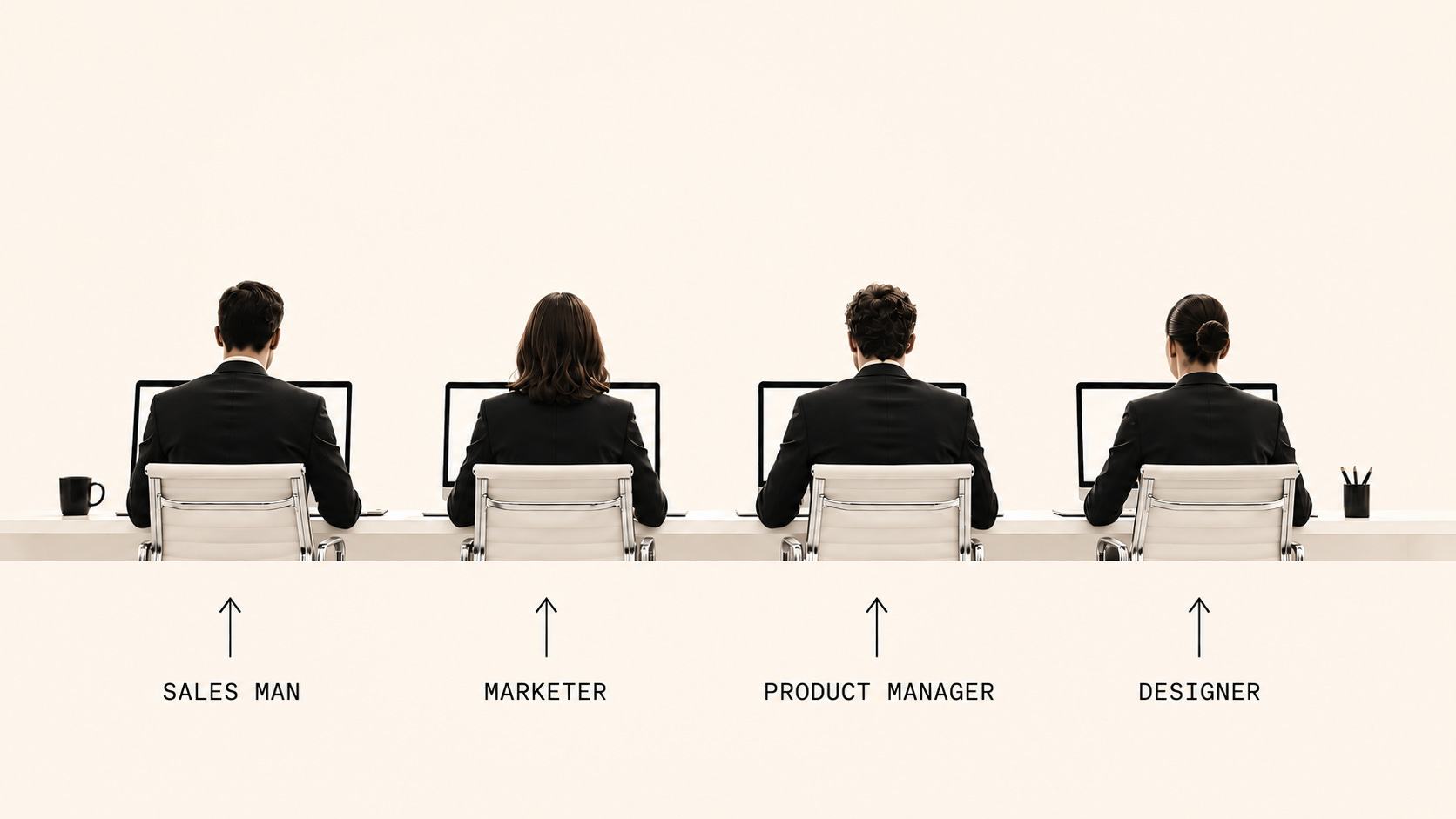
You don’t need to be a traditional software engineer to make the first version anymore. But you do need to have enough taste to know what good looks like, enough clarity to describe what you want, and enough patience to keep shaping the output when the computer gives you something that looks like your cat threw up on the screen.
The internet is obsessed with the build. People post videos of apps they made over a weekend. Founders show off internal dashboards. Executives start creating little agents between meetings and hand them to their teams on Monday like they came home from Home Depot with a homemade espresso machine.
“Look what I made.” - The CEO you want to murder today
Sometimes the thing is genuinely good. That’s important. A sharp person inside a business can build a tool that better fits the company than a platform charging $30,000 a year, because that person actually understands the work.
Then something funny happens.
Nobody cancels the vendor.
The invoice still clears every month. The contract auto-renews in the spring. Finance approves it because it looks like infrastructure.
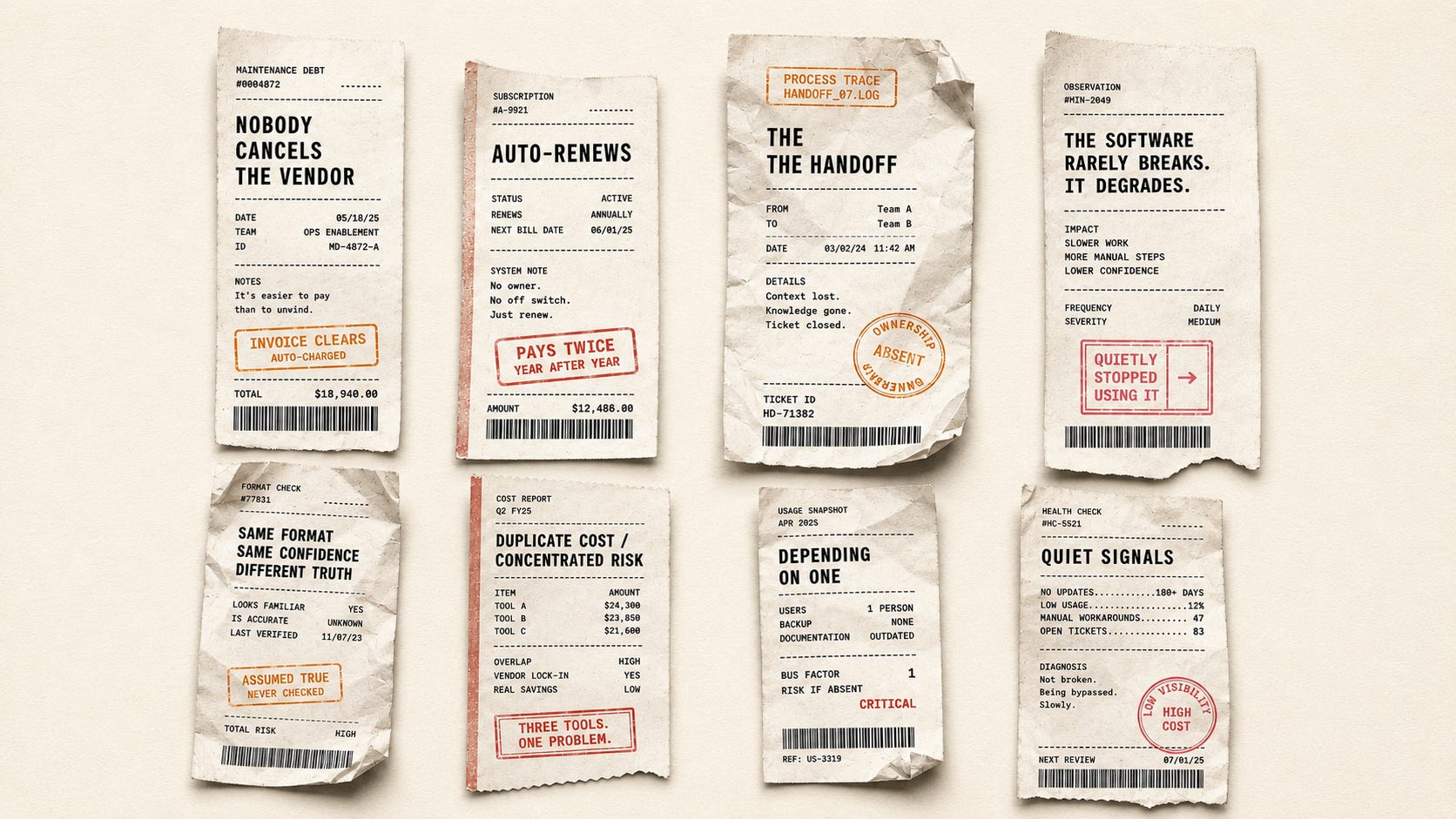
The internal tool stays too. Four people start depending on it because it works better. But only one person knows how it works, why it works, where the keys are, which assumptions are buried in it, and what to do when the system on the other end changes.
So the company ends up paying twice and depending on one.
That’s the position I keep seeing, and most organizations don’t realize they’re in it because both halves look like wins. The enterprise platform looks safe. The internal tool looks resourceful. Together they create duplicate cost and concentrated risk.
You probably already have one of these inside your company.
The handoff is where the truth shows up.
The person who built the shiny new tool has spent forty hours arguing it into existence. They understand every quirk because they created the quirks. Then they pass it to the team, and the team inherits a system nobody understands wtf is going on.
There’s no documentation because the maker never needed any (and probably couldn’t create it if they tried). There are no tests because it worked when they ran it. There’s a hardcoded API key buried somewhere anyone can use to run up your AI bill, and an assumption about the sales pipeline that stopped being true back in March.
The software rarely breaks in a cinematic way. It degrades one day at a time.
A model gets retired. A connector changes. An authentication flow gets updated. A field inside HubSpot is renamed and the chain starts passing empty values and erroring silently. One Monday the report comes out wrong, but it looks exactly as right as it did the Monday before. It looks the same but there’s no sign of truth to be found.
Six weeks later, the team has stopped using it. And nobody tells the executive because they love their prized creation, they whipped up between bourbon old-fashioneds.
That doesn’t make vibe coding bad. It means we need a better category for what it is.
Vibe coding is a whiteboard that runs.
It’s a wireframe that can answer back. It’s a sketch you can click. It lets someone with taste make an idea tangible enough for other people to react to, and that is incredibly valuable because most people are awful at responding to abstractions.
Show them a deck and they nod.
Show them a working interface and suddenly they have seventeen opinions.
Good. Now you have something to work with.
Treat vibe coding as the fastest thinking tool we’ve ever had and it becomes a superpower. You can skip weeks of vague debate and put a working idea in front of someone by the afternoon.
Treat the same prototype as production software and you’ve committed the company to maintaining a document of one person’s Tuesday.
The prototype answers one question: could this exist?
A product has to answer much harder questions.
Should this exist?
Can people trust it?
Who owns it?
What happens when the data is wrong?
What happens when the person who built it leaves?
What happens when fifty people use it in ways the original builder never imagined?
Personal software becomes organizational software the moment another person starts depending on it.
That transition is where most of the cost (and pain) lives.
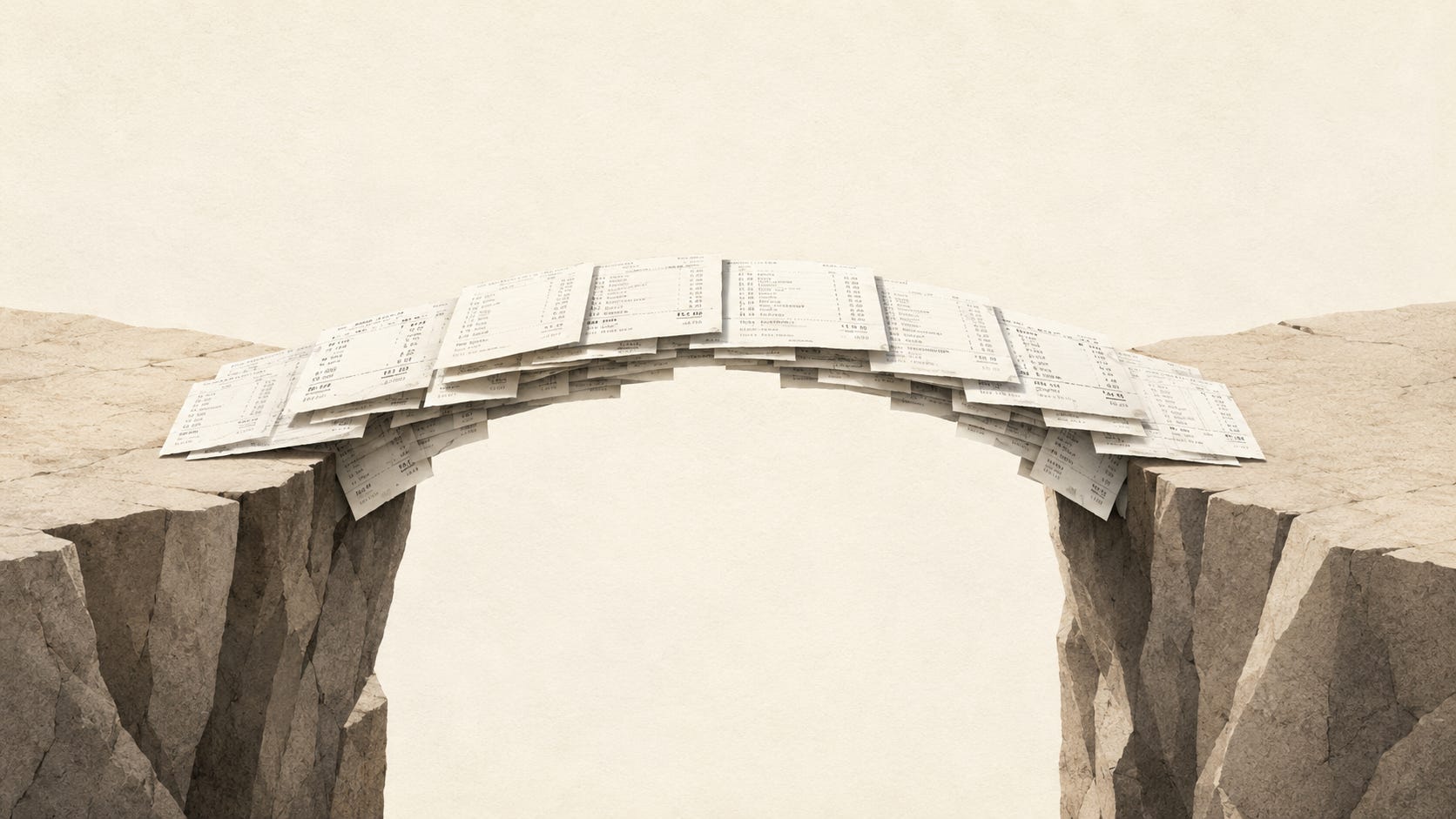
I’ve spent twenty-three years watching software move from idea to reality. First, I built things for brands. Then I invested in early-stage technology companies and helped shape products that had to survive the jump from founder instinct to real paying customers. Now I work with founders, executives, and creative leaders who are among the best in the world at what they do.
The common trait of the elite isn’t their technical ability.
It’s their taste, judgment, and discernment
They know what information matters. They understand the nuance inside their business. They can look at a dashboard and immediately see what is missing. They know which question opens the real problem and which answer is technically correct but practically useless.
For most of their careers, they had to squeeze that judgment into someone else’s software. Now they can build around it or on top of it.
That’s the part of personal software I find genuinely exciting. We’ve entered a world where the best people in a field can begin encoding more of their taste, judgment, memory, and decision-making into the systems around them.
A founder can have a digital chief of staff who follows them across the tools they already use. They can be driving, walking through an airport, or sitting in the five-minute gap between two meetings and talk through what’s happening. The system can surface the person they forgot to call, prepare context for the next meeting, dispatch an action to someone on the team, or explain what changed in the business without making them click through six dashboards and a spreadsheet called FINAL_v7_USE_THIS_ONE.xls
A creative leader can have a portable thinking environment. An idea arrives in the car or in bed at midnight. They capture it in their own language. The system connects it to earlier ideas, client context, research, and work already in motion.
That’s more than automation. It’s personal infrastructure.
And infrastructure changes the standard.
Software can be disposable. Infrastructure has to be dependable. Infrastructure needs ownership, uptime, documentation, permissions, monitoring, and a budget. The moment your custom tool becomes part of how decisions get made, customers get served, or money moves through the business, it stops being a clever experiment.
It becomes part of the company.
This is why I’m less interested in whether an AI system looks impressive and more interested in three brutally practical questions.
Does it save real time or money you can point at?
Does it create customers, margin, capacity, or better decisions you can trace?
And can you trust it tonight, when the person who built it isn’t in the room to check it?
Most vibe-coded internal tools pass the first question, ignore the second, and fail the third without telling anyone.
Trust is the killer. A system can save time and still be useless because nobody believes the output. It can generate beautiful work and create more anxiety than value because no one knows where the answer came from. It can be right ninety-five percent of the time and still be catastrophic when the missing five percent involves money, legal exposure, customer promises, or someone’s career.
Fast wrong answers aren’t productivity. They’re a toddler with an AK-47
The number of apps shipped is a lousy measure of progress. The real test comes after the prototype, when somebody has to own it, fix it and pay for it. Smart companies will make the hard call early. Some ideas deserve a real product. Others should stay sketches. And plenty were spreadsheets all along.
They’ll design the mechanic at the same time they design the luxury.
That mechanic may be an internal person. It may be a small team. It may be a partner who watches the models, maintains the integrations, checks the outputs, documents the system, and helps it evolve as the company changes. We run a company that does this, so if you need it, DM me.
The form matters less than the accountability.

Someone has to own the pond. Fix the pizza oven and service the mid-life crisis mobile.. cough.. I mean sports car.
This doesn’t mean HubSpot, Salesforce, Google, Microsoft, and the rest of the software world disappear. Their systems still hold the records. They manage permissions, history, workflows, security, and all the boring infrastructure that becomes very exciting the first time it stops working.
The shift is that those platforms may stop being the place where we spend most of our time.
For twenty years, humans adapted themselves to software. We learned the menus, fields, workflows, and strange internal logic of tools built to serve everybody.
Now software is beginning to adapt itself to us.
Software now lives where we work and how we work
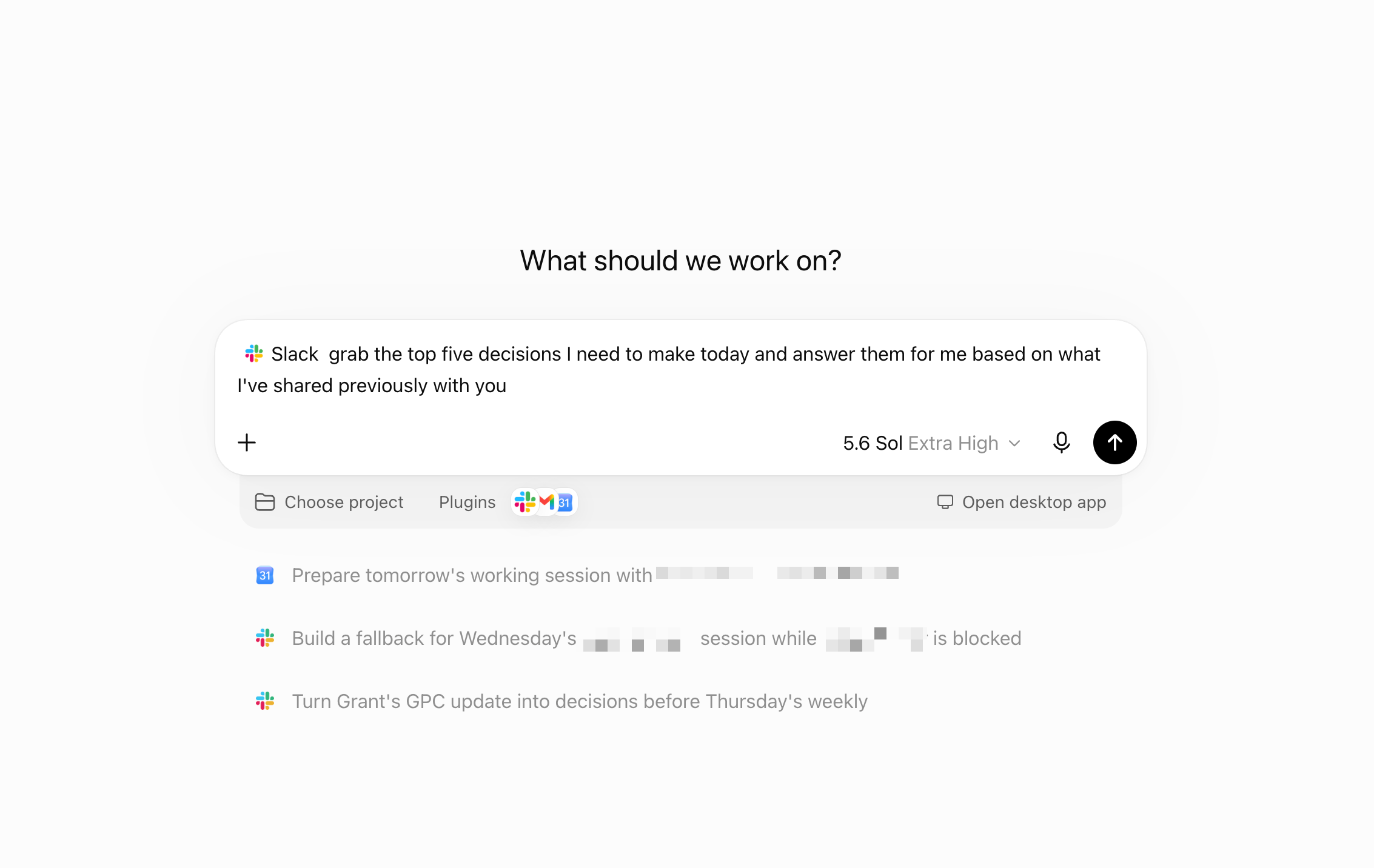
You may eventually interact with one familiar interface that understands you, then talks to dozens of systems behind the scenes. You ask for what you need in your own language. The system translates your intent into the rigid structures the underlying software requires.
The interface becomes personal. The infrastructure remains shared.
For years, companies bought giant software platforms and used a fraction of the features. Now we may build dozens of tiny custom tools because they’re cheap and easy to create, then discover we use a fraction of those too.
The cost moves. It doesn’t disappear.
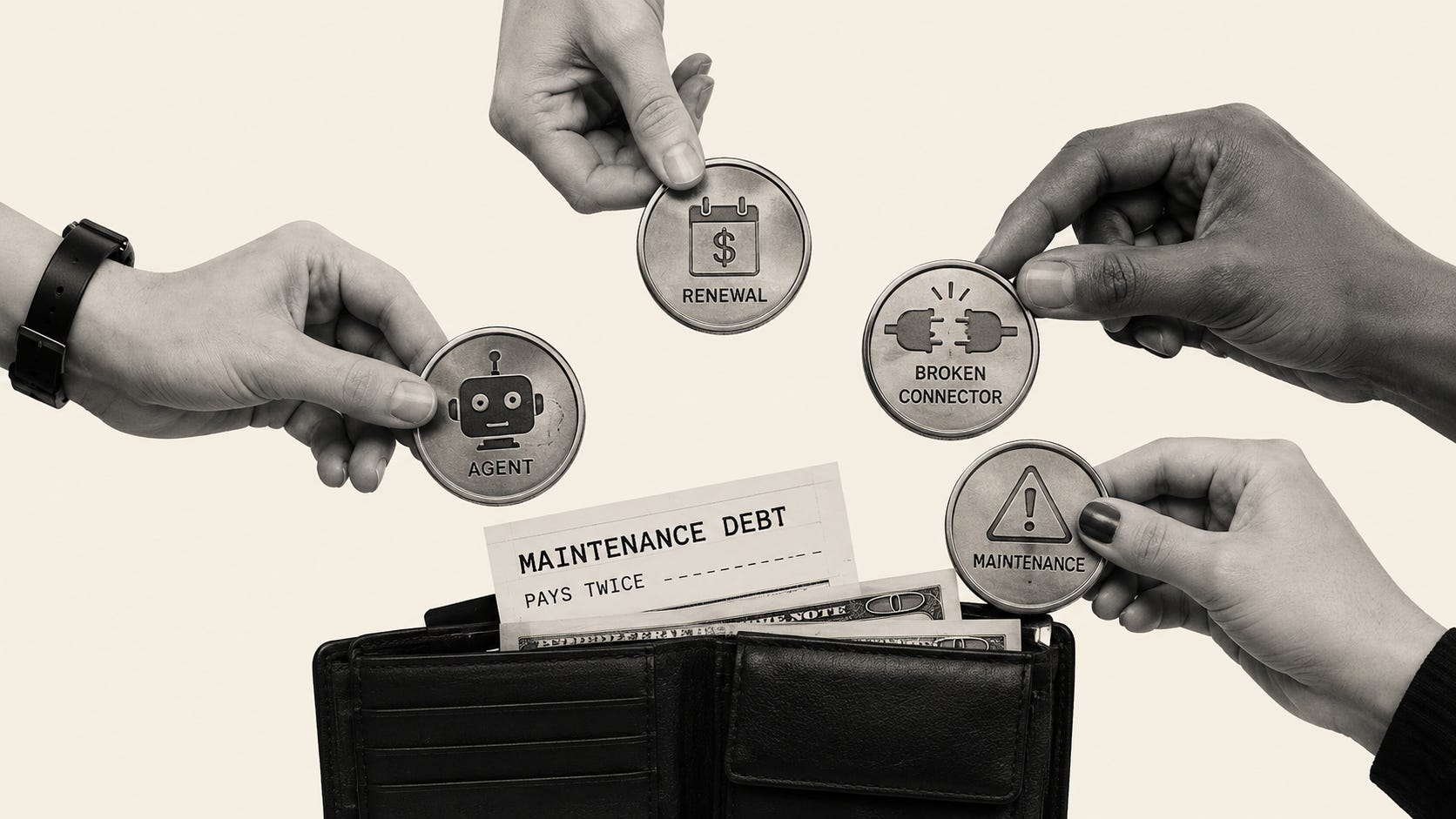
Instead of paying for bloated software, we start paying for abandoned software. Half-finished agents. Broken connectors. Personal dashboards that were exciting for three weeks and now send error emails to an inbox nobody checks.
We trade feature debt for maintenance debt.
I’m not telling anyone to stop building. I love this stuff. I build these systems for a living, and I’m not slowing down.
Personal software is absolutely the future. For the right person, built the right way, it can create an advantage that off-the-shelf software never could. It can help a founder see the business more clearly. It can give an executive access to the context they normally lose between meetings. It can make the taste and judgment of someone exceptional more available to the people around them.
This stuff is a new layer of business. And the mistake I keep seeing play out in the boardrooms and C-suite meetings I’m in is buying the fantasy without budgeting for the reality.
So the next time a software renewal crosses your desk, ask one question before you approve it:
Who here has already built a version of this?
Sometimes the answer will be nobody. Sign it and move on. Sometimes the answer will be a name.
Now you know what you may be paying for twice. More importantly, you know who you may be depending on alone.
Then ask the questions people usually wait too long to ask.
Who understands it?
Who checks it?
Who maintains it when a model changes?
What happens the week that person is gone?
Those questions aren’t meant to kill the experiment or rain on your innovation party. They’re how these experiments earn the right to become infrastructure you grow your company on.
I still love my koi pond. It’s beautiful. I’m glad it came with the house.
I just understand what I own now.
The fish are the visible part. The system is what keeps them alive. Thanks, Bob (my fish guy).
Your company is building a lot of beautiful new things right now. Tools shaped like the judgment of one sharp person, running on models that shift underneath them.
Could not agree with this more.
There is a massive disconnect when people are asking for custom solutions AND what they think it will take to maintain it.
Everything looks good day 1…maybe week1…but behind commercial softwares like Airtable, Notion, Gmail, etc., there are massive teams and budgets keeping them alive every day.
Just because someone can build it doesn’t mean they can also just walk away from it when it’s “done”.
It takes way more time, support and yes, money, than you probably realize.